Showing posts with label Llangollen Canal. Show all posts

Solar Eclipse on the Llangollen Canal, August 1999

Sky-gazing conditions in Northamptonshire are not suitable for observing today's partial eclipse of the sun, but we clearly remember the last eclipse.

On 11 August 1999 we were on our first cruise along the Llangollen Canal in our first boat Bertie. Around the Wrenbury area we were travelling towards the Hurleston when we experienced full totality. Conditions were not perfect but at least the cloud was broken and not a blanket.We observed the process in the reflection on the water of the canal, and also via a bucket of water carried on-board.  I got the picture below with my Minolta 35 mm film camera but you need an eye of faith to recognise it as an eclipse.

Eclipse above the Llangollen Canal, August 11, 1999

Perhaps the most dramatic part of the process was the very perceptible drop in temperature that occured; for a warm August for a while it got quite chilly. The eclipse also had on effect on bird-life. For quite a while this rural location became very quiet and still.

Bertie descending Grindley Brook Locks, August 1999

Canal, Cruises and Contentment by Austin E Neal


What a great title!

This is an early canal cruising book; published in 1921 and featuring cruises along the Ellesmere and Oxford Canals just before the First World War. The author lived near Derby and cruised the canals in his motor boats Hectic and Hectic Too. The book is from an age when motor boating was in its infancy. He is clearly enthusiastic (as the title suggests) about his pastime and keen to pass on his enthusiasm and knowledge others. The books contains chapters describing his two boats and their engine (note singular), the operation of locks, how to plan a cruise and the costs of operating a boat. He even has a chapter on washing up which some might find strange, but more of that later. Neal took along a camera when boating so the book has twelve high quality illustrations.

The book opens with a great passage describing the author's joy of canal boating:

"DITCH-CRAWLING" is what certain of my friends call it, mainly those who, living on, or near, the coast of this island, "go down to the sea in ships, and do business in great waters"

That these men "see the works of the Lord" I gladly admit; but the purpose of this little book is to point out, with all humility, that health, contentment, adventure (oft with a spice of danger), humour, faith, hope and charity, all in full measure, are to be found by he that possesseth a motor-boat and permission to travel "through, by, or over" the inland waterways of Merrie England.


As you can see he doesn’t hold back. You can also see that the term “ditch crawler” has a long history (over a century!).

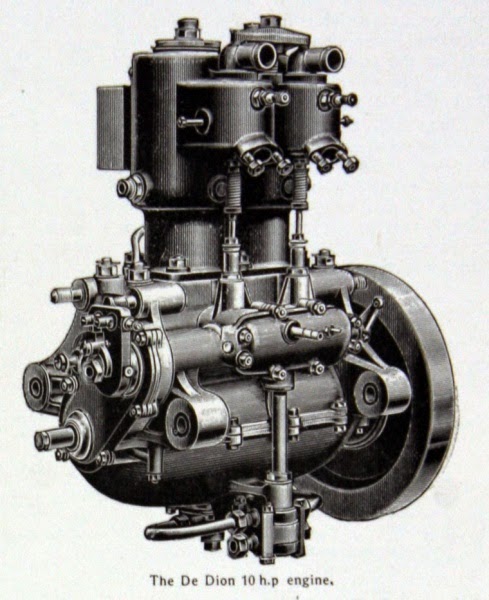
Neal spends a chapter describing his boats, the first was a converted ships lifeboat the second built to his specification in 1914 was 26 ft long with a 6 ft 6 inch beam. The beam was specified so the boat could pass through 7 ft locks and use “bumpers” (fenders) to protect the wooden hull; the draught was around 1 ft 6 inch because many of the canals were shallow. The engine he used was, in my view, a bit special. It was 1906 two-cylinder De Dion Bouton petrol engine rated at 12 HP and manufactured in 1906 for use in car. It had a form of magneto ignition augmented with a contact breaker. Neal moved the engine from Hector (1913) to Hector Too (1914). I searched the web and found an illustration that appears to fit Neal’s description. The engine had raw water cooling and a wet exhaust. Starting was by a handle and there was no electrical system on the boat.

De Dion 1906 Petrol Engine

The shadow of the Great War hangs over the book since the author wrote it shortly after the armistice and it is about cruises made just before hostilities began. Neal occasionally makes references to the Royal Flying Corp (RFC). At one stage describes flying over the Caen Flight on the Kennet & Avon. It appears that Neal was a 2nd Lieutenant in the RFC and his marriage in 1916 was recorded in Flight Magazine. He obviously kept a meticulous log, which formed the basis of the book, because he regularly reports details of his mileages and fuel use. 


One chapter, called “Under Way”, appears to describe an ideal day’s cruising on the Ellesmere (now Llangollen) Canal but it contains a curious description of double locks. It is possible that Neal was using artistic licence or possibly he was confused and recalled Hillmorton Locks on his Oxford Cruise. When cruising Neal usually had a male friend along for crew. The perfect day he describes includes cruising to Colmere. Along the canal they overtake several horse-drawn working boats.


So why a chapter on washing-up? The author states the obvious view (from what he describes as the fair sex) “just like a man to write a chapter about a job I can do in ten minutes”. He justifies the detail by explaining that the boat does not have an unlimited supply of hot water and has no sink. Neal appears to use canal water for cold water and heats it on a Primus Stove; two were kept on board. Neal washed plates and dishes in canal water followed a wipe with newspapers and perhaps some Vim. I realised when reading the chapter that we take stainless steel cutlery for granted. Knife polishing was an issue for Neal until he discovered “Lightning Knife Cleaner” which presumable is some form of abrasive cleaner that could remove corrosion. He also spends some time describing why fluted crockery is not a good idea since the fluting retains dirt. Although devoting a chapter to washing up was probably over the top, I can see, given the absence of facilities on his boats, why it was a particularly focus. A far cry from modern canal boats with all their facilities.


Neal eschewed newspapers (except for washing-up) while boating, so on August 4th 1914 he was unaware of world events and was enjoying boating on the Ashby Canal. That evening he got to just beyond Hawkesbury Junction. By the following afternoon he had reached Braunston and visited the village for supplies. Asking for a pound of butter he was greeted with “I might let you have half because I don’t know when will get more”. At was then that he discovered that the country was at war with Germany and. supplies of food suddenly had become very difficult because of panic buying. Crucially for his boating, petrol also became quite difficult to obtain because of government restrictions. Neal was told that it was required by the RFC. 

Neal passed through Foxton in 1914 on his way back home to Derby from Oxford


Neal ends his book by returning to his home near Derby from his 1914 Oxford Cruise with typical analysis of his log books. “380 miles, 189 locks, 40 gallons petrol and 9 ½ miles per gallon”. This was followed by another tribute to the charms of boating.

A charming evocative book from a century ago when life on the waterways and our country were very different. Although the book is quirky it is also has historical interest. Once I started reading it I just couldn't put it down. Copies are not particularly cheap, I paid over £30 for my copy, but it was printed on good quality paper with good binding and my copy is in excellent condition.

Barbridge


Wednesday (April 10th) we left Willey Moor and headed towards Hurleston. The forecasters were predicting warmer weather but that appeared to be more cloud with the promise of rain. It wasn’t long before we were lifting bridges. 

Raising Lift Bridge near Prees Branch

The electric lift ridge at Wrenbury was interesting as usual, with traffic quickly building up, but the approach is easier from the Llangollen direction because it is straight and not on the angle. 
Blue Pearl passing through Wrenbury Lift Bridge

We soon passed through Baddiley Locks where we moored on the way to Llangollen. A few boats were coming up through Hurleston so we had to pass them in the short pounds. The volunteer lock keepers were helpful and friendly.

Hurleston Reservoir

Leaving the bottom lock were hampered by a boat entering lock. Both Blue Pearl and Albert turned north towards Barbridge and we moored up for the night just before the junction. For the first time on this trip we found the “Shroppie Ledge” underneath Albert. The Kinning’s lent us their floating rubber wheels to move Albert out from the bank.


Willey Moor Lock

On Tuesday it was sunny so instead of moving on we walked from our mooring at Blake Mere to Cole Mere and then walked around the lake. The meres around Ellesmere are extensive and well worth exploring.

Picturesque Cottage at Cole Mere

Fallen tree at Cole Mere

By the time we had moved off, mid morning, the weather had started deteriorating. By the time we crossed Whixall and Bettisfield Mosses it was dull and windy. 

Operating a Lift Bridge near Prees Junction

Both Albert and Blue Pearl took on water at Grindley Brook. It was very quiet so going through this notorious bottleneck was simple. The lock keeper was particularly chatty and helpful.

Maggie at Grindley Brook
Leaking middle gates at Grindley Brook
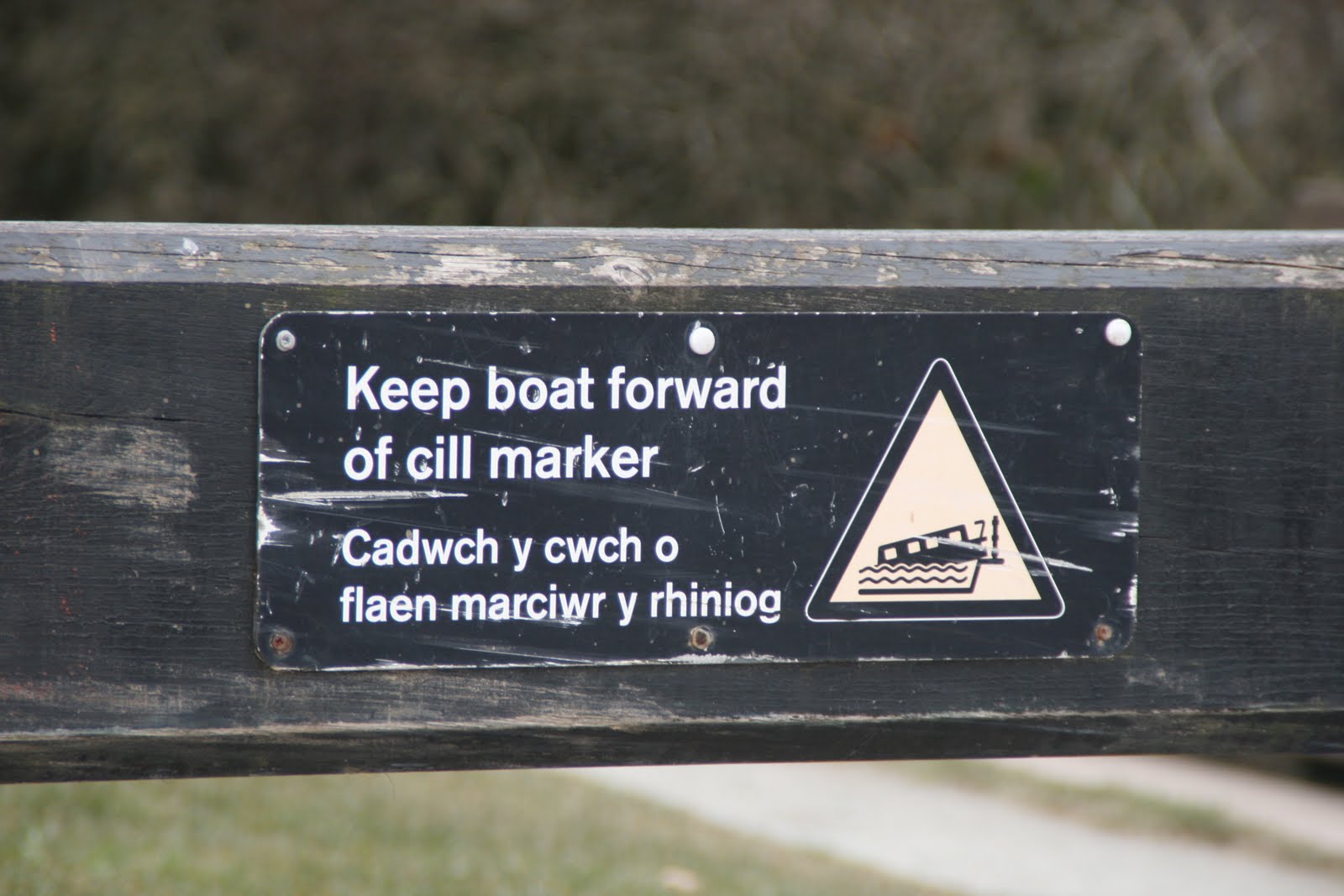
Bilingual warning notices
We passed through Povey's Lock and moored up just above Willey Moor Lock. It was a late in the day and we went to the Willey Moor Lock - the pub that is. The fish and chips we had were great and they had a good selection of real ales. One of the features of the pub are its collections of teapots and Toby jugs.

Part of the extensive teapot collection at Willey Moor Lock Inn


Blake Mere, Ellesmere

Monday was not particularly sunny, and although it was windy it wasn't as windy as when we passed through this section on the way to Llangollen. There was again some delay at New Marton Locks.

Pretty Knot Garden at New Marton Locks

As we passed through Frankton Junction a boat was coming up from the Montgomery Canal.  

Frankton Junction signpost (plus pigeon)

Frankton Top Lock


Beech House Ellesmere, former canal company headquarters
We stopped for late lunch at Ellesmere Wharf. We were joined by Cutter an unique boat designed and built by Martin Fuller. I had good chat with Martin. He had built the boat in his garden over 20 years. It resembles some tunnel tugs and icebreakers but is truly an individual design.  Martin was particularly proud of Cutter's transom stern. It is powered by a Lister that came from a dumper truck.

 Martin Fuller and his boat Cutter


Cutter at Ellesmere Wharf
Later in the afternoon we moved out of Ellesmere and moored up at a delightful mooring by Blake Mere. What a wonderful view from our cabin window. The only negative about this location is that it is a digital black hole - no 3G internet, no mobile phone and not TV reception - just the spot to get away from it all. A grebe was fishing in the lake and a kingfisher flashed by our mooring.

Blake Mere - view from our mooring

Post corrected 13 Oct 2013

Chirk (Again)

On Sunday we left Llangollen after visiting the local shops - so we had a leisurely start. The weather was still cold and dry and we followed a number of other boats down towards Trevor.

Leaving Llangollen


Going through the narrows near Llangollen

Maggie strolling along the towpath near Llangollen

Blue Pearl & Albert moored up for lunch at Sun Trevor. Although the sun did not break through the high cloud the views along the Dee Valley still impressed. We crossed the Pontcysyllte Aqueduct in a line of a number of boats - it was quite busy. With no sun we didn't quite have the views we had on Friday.

A busy Sunday on the aqueduct

The  tight gap between the boat and trough edge on the aqueduct 
(the gap is about the same on the other side)
Albert crossing the Pontcysyllte Aqueduct

Newbridge Railway Viaduct near Trevor seen from the Pontcysyllte Aqueduct

Once you turn at Llangollen you start travelling downstream. This is because the Llangollen Canal has a flow towards Hurleston Reservoir. This greatly reduced the drag going through tunnels and other channel restrictions such as bridge holes. The Chirk Aqueduct which has a particularly tight channel, because the towpath is solid and not suspended, was much easier to cross on our return.  


Blue Pearl leaving Chirk Tunnel

Blue Pearl Crossing the Chirk Aqueduct
Welcome to England

We moored up just after crossing the Chirk Aqueduct, close to the Poacher's (Pocket) near Rhosweil. Unfortunately, this was the first of several nights when we found the 3G reception poor. We couldn't post, hence the delay in posts.


Llangollen

We stayed over in the basin at Llangollen on Saturday and visited some of the local attractions. With the Kinnings we spent most of the day exploring the Dee Valley using preserved Llangollen Railway. This steam hauled railway runs up the Dee valley close to the canal feeder so we were able to visit the source of the Llangollen Canal, the Horseshoe Falls.

Waiting for us at the terminus in Llangollen, which is close to the canal basin was a train headed by by the GWR-class 4-6-0 engine Foxcote Manor.


The weather was cold and bright so the views along the valley were spectacular. Foxcote Manor had a good head of stream which also looked marvelous, particularly when seen against the blue sky.

River Dee from the train

The 10-mile route passes very close to the river in several places. At one bend in the river we passed a fly fisherman standing in the river (in waders of course).  The line along the valley also includes a 600 yd tunnel. Since the carriages were not lit, the crew came through the train and were stationed at suitable intervals with torches. It was very dark in the tunnel and the experience was made more interesting when smoke filled the carriage through a part open window.

Snow drifts at Carrog Station
The train terminated at Carrog so we go off the train to watch Foxcote Manor run around the carriages ready to take the train back down to Llangollen. With all the snow around, and the rural location, it was very picturesque.

Carrog Station 

Foxcote Manor with a good head of steam at Carrog

We broke our return journey at Berwyn and had lunch at the Chain Bridge Hotel which is being refurbished. The views of the river from the lounge were wonderful. Groups of canoeists were shooting the rapids below us. It appears that the chain bridge itself, which is in poor condition, may also be refurbished.

Chain Bridge and Chain Bridge Hotel

After lunch we walked up the Horseshoe Falls. This is where a curved weir is used to control the feed of water into the Llangollen Canal. 

Horseshoe Falls, River Dee
Valve house where the water entering the canal is metered

We returned to Llangollen on the next train and had afternoon tea on a picnic bench at the basin. The sun was warm for a while.


Pontcysyllte Aqueduct & Llangollen

On Friday we woke to a clear bright day and headed towards the Pontcysyllte Aqueduct - Telford's masterpiece. The was plenty of snow around on the towpaths, fields and hills. The last time we went across the aqueduct, in our previous boat, it rained so hard that it was difficult to see the ground below and my SLR camera, which I got ready to record the event, failed. It was therefore wonderful to find that not only would our crossing be dry, not windy, and the sun would be shining, but the scenery would be enhanced by a liberal covering of snow. To misquote Greg Wallace from Masterchef "Boating doesn't get much better than this!"

Poncysyllte Aqueduct 
Blue Pearl on the Aqueduct

Snow on the hills and shadows on the football field 
 
Spectacular shadow of Blue Pearl crossing the aqueduct, courtesy of Caroline Kinnings
The Kinnings enjoying crossing the aqueduct

Albert on the Aqueduct

We took our time crossing and then turned towards the narrow section of canal that leads to the town of Llangollen. The towpath was quite icy and the snow and wind had also caused havoc with trees. Several trees had fallen across the canal and had only recently been cleared.

Fallen trees
Beautiful rural setting of the route to Llangollen
A stranger in these parts! (and icy towpath)

I had been a little worried about the depth of water in the navigable feeder, with Albert's deep draught, but it wasn't bad with only the occasional bump on rocks in the channel bed. The narrow sections did, however, slow us down considerably. 

Arriving at Llangollen Wharf

Horse drawn trip boat William Jessop

We moored up at the basin at the end of the navigation. The sunshine, blue skies and snow on the hills made it a magical place to moor up. 

Llangollen Basin Visitor Moorings