Showing posts with label Kennet and Avon. Show all posts

Bradford on Avon

Albert in Bradford on Avon lock, December 2003

Boat in Bradford on Avon Lock, January 2019


The other weekend, well January 19/20th to be precise, we stayed with our extended family at Woolley Grange near Bradford on Avon to celebrate Maggie's 70th. We chose the location because we wanted  a luxury hotel and to have all the family around. It's not the best time of the year to have a birthday because you can't rely on the weather and the Saturday of the weekend was no exception.

Now regular readers (are there any?) and friends will know that Bradford on Avon means quite a bit to us having purchased Albert from Bradford in late 2003. We spent some time in Bradford on Avon Marina during the winter of 2003 waiting for the stoppages to be lifted so we could bring Albert up the Thames, Oxford Canal and Grand Union to Yardley Gobion.

Lock Inn Cafe, Bradford on Avon
(Note the sign related to Brexit)

A wet Lock Inn Cafe

One of the pleasures of boating around Bradford over 15 years ago was visiting the wonderful Dick & Jane's lock-side cafe with its quirky surroundings and wholesome food. We just had to visit there again on the Saturday - on an impulse .

Now you may remember that we had particularly heavy rain on the Saturday, but in a break in the rain we trudged down to the canal to find Dick and Jane's (a.k.a the Lock Inn Cafe) is still very much as before. The only problem we had was our large family group couldn't easily fit into main rooms which were busy with loads of other families. We had to eat outside under and awning fitted with space heaters because the rain started again. Not the best situation, but then we should have booked! However, its good to know the cafe still popular - long may it be so.

I have to point out that Sunday's weather was was much better and over the weekend we made full use of the hotel's brilliant facilities (spa and pool). Just a pity we didn't arrange to have better weather on the Saturday!

A Decade with Albert!

On December 6th 2003 we completed the formalities for the purchase of Albert from her first owner who fitted her out, Mike Hurd. So I thought I would go down memory lane to celebrate our decade.

First time steering Albert on the Kennet and Avon near Bradford-on-Avon
with Mike Hurd watching over me

Negotiating our first lock with Albert, Bradford-on-Avon
December 30th, 2003

Ten years on we can look back on many happy journeys. With Albert we have travelled far and wide;

north to Gargrave on the Leeds and Liverpool Canal,

south to Guildford on the Wey Navigation,


east to Wissington on the River Wissey,

and west to Llangollen.

Rowing Holiday by Canal in 1873 by A Farrant


Not so much a book, more of a booklet, and published just over 100 years after the journey, so what is it all about?

In the 1970’s the grandson of A Farrant, only identified in the preface to the booklet as “Mr Farrant”, transcribed the notes of a rowing journey that his grandfather and three Oxford friends made. The notes were shown to Dr Edwin Course who recognised that, although they were not a great literary work, they were of historical interest and likely to appeal to waterways enthusiasts.

In the preface Dr. Course points out that the Oxford pals journey followed the popular trend in the 1860’s and 1870’s for pleasure traffic on the waterways, probably encouraged by the publication of The Oarsman’s Guide to the Thames. He thought that many similar logs were kept but only a few were published. This is very much a log, not a literary work, not written for posterity, and although light in tone it cannot be considered alongside the hilarious Jerome K Jerome’s Three Men in a Boat which describes a contemporary journey. The log was written only for the writer and his friends and they were not even identified in the script. The dates of the journey were originally unknown but research by Course pinpointed them and the booklet includes a very handy map of the journey including a timeline.

Who were the oarsmen? Farrant’s grandson thought they were John Salter (a boat builder), T Marsh, Ansty and the author; A Farrant. The log records them starting their journey from “Salters Slope” by Folly Bridge in Oxford so I presume that John Salter was connected to the family boating business that still operates there today. Salter Bros. started at Folly Bridge in 1858 and John Henry Salter would have been 19 years-old at the time and destined to become Mayor of Oxford (1902/3). The Salters were prominent Liberals which might explain why the log mentions the Liberal Fete to be held at Gloucester (Monday 18th August 1873).

Folly Bridge, Oxford in 2010

So what of the journey? It is certainly one that could not be achieved today. They start and end their journey at Oxford but travel to Monmouth via the Oxford Canal, Warwick & Napton Canal (now part of the Grand Union), River Avon, River Severn, Hereford & Gloucester Canal (now disused) and River Wye. They then return via the Great Western Railway (more of this later), Avon Navigation (“Bristol Avon”), Kennet & Avon and River Thames. All of this achieved in just 20 days in August.

It is important to recall the era of the journey. Canals were not the predominant mode of transport and the Railway Age had arrived but many great railway developments were yet to occur; the Great Western were still operating and building broad gauge lines. However, the canal to Hereford was not completed until 1845, just over 30 years earlier. River transport was generally in decline as the pals were to find out, particularly on the Warwickshire Avon.

The four pals left Oxford and travelled upriver to the Oxford Canal. The log describes how they negotiated the narrows by lift bridges and how they overtook narrow boats (or barges as they term them). The technique appears somewhat adventurous. They would pull up alongside the barge and then “work past the barge by hanging on the side.” Once in front of the barge they would pull away sharply to avoid being run down by the moving barge. To me it is not surprising that one “bargee” near Kidlington was “ungentlemanly” and obstrepulous (sic)”. I would have thought that more than one “bargee” would object to this technique which appears reckless to me.

They noted that Leamington Spa was “a bright looking and modern town”. Not surprising since most of the spa-related developments had occurred in the 19th century and the “Royal” prefix was only awarded by Queen Victoria in 1838.

The journey down the Warwickshire Avon appeared troublesome with lack of water just below Warwick and the boat was damaged requiring a repair by John Salter. After the Avon, they joined the River Severn at Tewkesbury and on their 8th day they entered the Hereford and Gloucester Canal. They camped each night and most nights they set traps for rabbits but without success. Farrant usually reported this as “the rabbits were very old” – meaning they were wise enough not to put their heads into the snares they had set. They also tried fishing but with limited success and entertained themselves by singing.

The passage through the 1 ¾ mile long Oxenhall Tunnel (now under the M50) required a light and two people in the bows to keep the boat in the centre of the channel with the other two in the stern “paddling with stretchers” (as opposed to rowing). It was a good job that they didn't meet any working boats in the tunnel given that the Hereford Times carried articles in May 1851 about an incident in which boats travelling in opposite directions had met in the middle, and neither would give way for 58 hours! That would definitely be “ungentlemanly”.

The journey down the River Wye was not without incident. They followed some local watermen downstream of Ross to keep in the channel but managed to capsize their boat. Arriving at Tintern, where they visited the abbey, they had a conundrum, how to get to Bristol and Bath?

After their escapades on the Wye, they recognised that crossing the Severn in a rowing boat was going to be difficult so they decided on the safer option; putting their boat onto a steamer that was leaving the next day. Unfortunately that arrangement fell through so rowed down to Chepstow where they loaded their boat onto a Great Western Railway train which took them across the New Passage.


New Passage - Portskewett Pier (G J Stodart 1887)

The New Passage ferry crossing of the Severn was opened in 1863, just 10 years before the journey, by the Bristol and South Wales Union Railway and was part of the standard route from London to Cardiff and the South Wales coalfields. The Welsh side of the crossing featured a substantial pier, presumably designed by Isambard Kingdom Brunel along with the rest of the railway as the plaque at Bristol Temple Meads indicates. 

The building of the Severn Tunnel was begun in 1873 but it took until 1886 for the tunnel to be opened and the New Passage ferry to become redundant, so the four might have seen the construction work being carried out nearby. It is a pity that the log does not describe in detail what would have been the most interesting part of journey. But, as Edwin Course pointed out, the log was written for private use by the friends and not for posterity.
Severn Tunnel

Once on the “English” side the four travelled by train to Bristol Temple Meads. The boat travelled on top of the train, which was the way a lot of luggage was carried at that time, although not usually boats, a point alluded to by the author. Getting the boat onto and off the train (twice) must have taken some effort. Once at Bristol they left as soon as possible, even though it was late in the day, because the area around Bristol Temple Meads was “strong smelling” and not suitable for overnight camping.

They enjoyed their trip through Bath towards Bradford on Avon on the Kennet and Avon and then tackled the “formidable 29 (locks) at Devizes” operating some conventionally before getting the boat out of the water and putting it on wheels for the next eighteen. Just after Hungerford they took to the River Kennet which ran alongside the canal.

The weather was not always ideal for rowing during their journey, it often rained, and near Newbury they suffered strong winds. They disliked the lock mechanisms beyond Newbury because of their difficult lever-operated paddle gear and when they reached the Thames at Reading they were very pleased to find a lock operated by a lock keeper.

The fact that this  booklet exists is not only due to its writer, and his grandson, but also to Dr. Edwin Course who did much research providing not only a preface, extensive notes and footnotes, but also photographs mostly taken in the 1970’s of the sites mentioned in the log. These images, now over 40 years old, are also historic. The photographs in the booklet of the yet to be restored Kennet and Avon Navigation are perhaps the most interesting.

Edwin Course appears to have gone on to edit and write several historical books and journals mostly focussed on Hampshire and transport. It is particularly poignant that the grandson of Farrant who transcribed the log did not live to see this booklet published, he died in 1973 one hundred years after the journey described by his grandfather.

My copy was purchased through eBay for just over £10 but there are many others available at similar prices, according to a quick search with my browser.

George Gibson


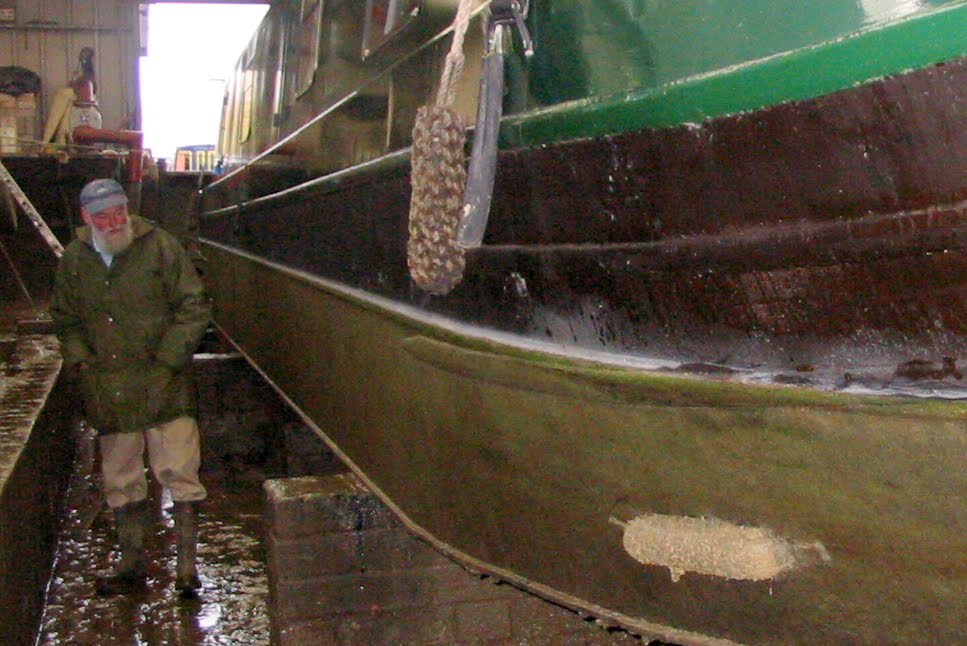
George Gibson inspecting NB Albert at Widbrook Dry Dock, November 2003

I notice that in Waterways World there is an obituary to George Gibson, a waterways entrepreneur on the Kennet & Avon Canal, who has died aged 82.  In 2003 we explored the K&A in our our first boat, Bertie. Reaching Honeystreet late on a sunny summer evening, we stopped to use the facilities provided by George at the Old Builders Wharf and ended up having a long chat. George let us moor up for the night at his delightful "end of the garden" mooring. The site was immaculate reflecting his Royal Navy training - George was an engineering officer in the Fleet Air Arm. He was well qualified in engineering being a Chartered Engineer, Member of the Institution of Mechanical Engineers, and Fellow of the Institute of Marine Engineering, Science & Technology.

Later in 2003, when we bought Albert from Bradford-on-Avon, it was logical that we should call on George to carry out the purchase survey. I was present at the survey in the dry dock in Bradford-on Avon and was able to benefit from George's informal advice. I will always remember him lifting the boards above the prop shaft and pointing out that in the Royal Navy, when they transported beer in cutters, they always stored it under the boards near the prop because that was the coldest spot on the boat as it was surrounded by water.

I found out that George was already familiar with Albert from a earlier Boat Safety Certificate inspection. He not only provided us with great service but  he managed to introduce humour into his report, noting that a a one-bottle gas system with no auto-change over had the potential to ruin meals! He finished his report with the statement that it was a pleasure to survey Albert, it was also a pleasure to meet him and benefit from his opinions.
Old Builders Wharf, Honeystreet, August 2003

Bristol

Nearly 10 years ago we came to Bristol Docks with our first boat Bertie on a "there and back" Kennet & Avon cruise - we didn't fancy the Bristol Channel. We moored up overnight on a pontoon outside what was then Lloyds TSB just by Bordeaux Quay. Ocean Princess with James Griffin and his crew joined us on the pontoon after their epic South Coast sea voyage.

This last weekend we came to Bristol to attend a wedding and couldn't resist visiting old haunts. We walked down to the docks on Friday evening. Can't wait to get boating this year - not long now.

Quad Sculler training

Moorings by the Arnolfini


Trip boat leaving Bordeaux Wharf