Below is a video of Albert going down the Anderton lift last week. Steve took the video with his Nokia N95 and then edited it using Windows Moviemaker. We hope you enjoy it.
Showing posts with label River Weaver. Show all posts
Showing posts with label River Weaver. Show all posts
To Anderton (7 April)
On Tuesday, we woke to bright sunshine, after the night’s rain, and decided to go ahead with our plan to travel downstream to the end of the navigation. Overnight the solitary shellduck was joined by a mate. They spent some time flying around the area together making calls that sounded like they were discussing nesting sites. The Devil’s Garden looked a picture in the morning sun so we walked over to the bank above the mooring to look at the clumps primroses.

Mooring at Devil's Garden

Primroses at the Devil's Garden
The journey down to Frodsham was delightful although from being dead calm the wind began to get up. After we went under the M56, and passed Runcorn Rowing Club, we got into the area of heavy chemical industry. It is certainly an enormous complex. At Marsh Weston lock, where you can branch off to the Manchester Ship Canal (MSC)if you have permission and is signed as Marsh lock, BW were installing some floating pontoons so it was not possible to stop even if we wanted. The next section of the navigation is the Weston Canal. We went on right to the end. Pearson quite rightly describes as the “end of the world”. As Maggie put it, we went from the Devil’s Garden to the end of the world, very apt really.

Chemical Works alongside the Weston Canal

The "End of the World" - Limit of Navigation Weston Canal
The limit of navigation is very desolate with the bottom lock gates of the Runcorn flight, which connected to the Bridgewater Canal, lying in ruins. This lock is the other end of the flight that appears in the 2009 IWA Calendar as photographed by Granny Buttons. Turning was not easy in the wind but we managed it.

Entrance to the disused locks on the Runcorn and Weston Canal
We moored up and walked through the industrial detritus to see the view across the River Mersey and the Manchester Ship Canal. It appears that this point is where the MSC store their spare lock gates. The mountains of North Wales were clearly visible but it was very windy, making the experience even more intense.

Manchester Ship Canal lock gates and views of the River Mersey.
The return journey upstream appeared a lot quicker, perhaps it was because we had the wind behind us, or perhaps it was because return journeys always appear to be quicker. We took on water, had a sandwich lunch at Dutton’s Lock, and met a pair of families with six little boys who were full of questions about boats and locks. They were particularly intrigued about the process of taking on water and why.

Iris Abbott on her way to the Easter boat gathering at Ellesmore Port
We arrived at the Anderton Lift at about 3.30PM and immediately went up the lift. The process of going up was equally fascinating. The high wind didn’t appear to cause us much problems. However, we had to turn south out of the junction and immediately wind (turn) to get ourselves “pointing in right direction”. The wind didn’t make this at all easy. However, we managed to reverse up to the 24 hour moorings.

Entering the Anderton Lift from the River Weaver
Tomorrow we plan to get to Preston Brook. We hope the wind drops.
Mooring at Devil's Garden
Primroses at the Devil's Garden
The journey down to Frodsham was delightful although from being dead calm the wind began to get up. After we went under the M56, and passed Runcorn Rowing Club, we got into the area of heavy chemical industry. It is certainly an enormous complex. At Marsh Weston lock, where you can branch off to the Manchester Ship Canal (MSC)if you have permission and is signed as Marsh lock, BW were installing some floating pontoons so it was not possible to stop even if we wanted. The next section of the navigation is the Weston Canal. We went on right to the end. Pearson quite rightly describes as the “end of the world”. As Maggie put it, we went from the Devil’s Garden to the end of the world, very apt really.
Chemical Works alongside the Weston Canal
The "End of the World" - Limit of Navigation Weston Canal
The limit of navigation is very desolate with the bottom lock gates of the Runcorn flight, which connected to the Bridgewater Canal, lying in ruins. This lock is the other end of the flight that appears in the 2009 IWA Calendar as photographed by Granny Buttons. Turning was not easy in the wind but we managed it.
Entrance to the disused locks on the Runcorn and Weston Canal
We moored up and walked through the industrial detritus to see the view across the River Mersey and the Manchester Ship Canal. It appears that this point is where the MSC store their spare lock gates. The mountains of North Wales were clearly visible but it was very windy, making the experience even more intense.
Manchester Ship Canal lock gates and views of the River Mersey.
The return journey upstream appeared a lot quicker, perhaps it was because we had the wind behind us, or perhaps it was because return journeys always appear to be quicker. We took on water, had a sandwich lunch at Dutton’s Lock, and met a pair of families with six little boys who were full of questions about boats and locks. They were particularly intrigued about the process of taking on water and why.
Iris Abbott on her way to the Easter boat gathering at Ellesmore Port
We arrived at the Anderton Lift at about 3.30PM and immediately went up the lift. The process of going up was equally fascinating. The high wind didn’t appear to cause us much problems. However, we had to turn south out of the junction and immediately wind (turn) to get ourselves “pointing in right direction”. The wind didn’t make this at all easy. However, we managed to reverse up to the 24 hour moorings.
Entering the Anderton Lift from the River Weaver
Tomorrow we plan to get to Preston Brook. We hope the wind drops.

To Dutton, River Weaver (6 April)
The weather today was not the bright sunshine we had yesterday. As the day progressed, the weather deteriorated into rain. We went further upstream to the limit of BW navigation at the Red Lion, Winsford. Although the area is more industrialised than the Vale Royal Cut, it was still very pleasant with wide sweeping bends and wooded valley sides. The Salt Union rock salt mine just before Winsford was particularly interesting. There was evidence that, because of the hard winter, their piles of salt are a lot smaller than they had been. It was tempting to go onto the Winsford Flash but the dire warnings in the BW literature put us off, especially with Albert being deep-draughted. Winding at the Red Lion was tight, in river terms, but it was perfectly possible.


Salt Union mine near Winsford
We went downstream in time for the 10.30 locking at Vale Royal Large Lock. In response to Steve’s enquiry, at Hunt’s Lock he received an explanation of the operating principles of River Weaver’s un-mechanised larger locks from the lock keeper. The locks are “hand operated”, or more exactly, mechanically operated. The sluice (or ground paddle) mechanisms are circular, and are raised by a pulley and chain system. The gates are opened (and closed) by chains that go diagonally across the lock. Each gate has a mechanism for opening, and a mechanism for closing. The mechanisms are water-driven using turbines with the water supply coming from the head of water above the lock. The water turbines drive a 5-stage reduction gear connected to a clutch. To open the gate the water supply to the turbine is turned on (the sluice opened) and the turbines are spun up. The clutch is then engaged by lever. If the gate is a bit “sticky”, the process can be hand-assisted using a capstan When we went through Vale Royal Large Lock, the mechanisms had to be assisted.

Cylindrical paddle mechanism, River Weaver Navigations
Chain and pulley in foreground with paddle behind

Hydraulic operating system for lock gates, River Weaver Navigations
Capstan in the foreground with clutch in background and gear train below
We stopped for water and lunch at Northwich, by the swing bridge, and then went on past the Anderton Lift onto Saltersford Locks and then Dutton Locks. The locks downstream of the Anderton Lift are all electrically operated. Again all the operators were very helpful and obliging.

MV Chica sunk at Dutton Locks since 1993
We sought out the Devils Garden moorings, which the crew of Blue Toad, the boat we shared Vale Royal lock with yesterday, had recommended. Although not an official mooring, the lockkeeper at Dutton gave us detailed instructions of its location and we found it easily. The Devils Garden is indeed a delightful mooring although it it is now raining so we cannot enjoy it fully. You should note that uphill from Dutton Locks on the River Weaver is Dutton on the Trent & Mersey Canal, hence the title of this posting.

Devil's Garden moorings
Today we saw jays, and a shellduck. However, when were passed by an oystercatcher we knew we were close to the sea. Tomorrow we plan to get to the docks at Runcorn, to look at the Manchester Ship Canal, and then return up the Lift.
Salt Union mine near Winsford
We went downstream in time for the 10.30 locking at Vale Royal Large Lock. In response to Steve’s enquiry, at Hunt’s Lock he received an explanation of the operating principles of River Weaver’s un-mechanised larger locks from the lock keeper. The locks are “hand operated”, or more exactly, mechanically operated. The sluice (or ground paddle) mechanisms are circular, and are raised by a pulley and chain system. The gates are opened (and closed) by chains that go diagonally across the lock. Each gate has a mechanism for opening, and a mechanism for closing. The mechanisms are water-driven using turbines with the water supply coming from the head of water above the lock. The water turbines drive a 5-stage reduction gear connected to a clutch. To open the gate the water supply to the turbine is turned on (the sluice opened) and the turbines are spun up. The clutch is then engaged by lever. If the gate is a bit “sticky”, the process can be hand-assisted using a capstan When we went through Vale Royal Large Lock, the mechanisms had to be assisted.
Cylindrical paddle mechanism, River Weaver Navigations
Chain and pulley in foreground with paddle behind
Hydraulic operating system for lock gates, River Weaver Navigations
Capstan in the foreground with clutch in background and gear train below
We stopped for water and lunch at Northwich, by the swing bridge, and then went on past the Anderton Lift onto Saltersford Locks and then Dutton Locks. The locks downstream of the Anderton Lift are all electrically operated. Again all the operators were very helpful and obliging.
MV Chica sunk at Dutton Locks since 1993
We sought out the Devils Garden moorings, which the crew of Blue Toad, the boat we shared Vale Royal lock with yesterday, had recommended. Although not an official mooring, the lockkeeper at Dutton gave us detailed instructions of its location and we found it easily. The Devils Garden is indeed a delightful mooring although it it is now raining so we cannot enjoy it fully. You should note that uphill from Dutton Locks on the River Weaver is Dutton on the Trent & Mersey Canal, hence the title of this posting.
Devil's Garden moorings
Today we saw jays, and a shellduck. However, when were passed by an oystercatcher we knew we were close to the sea. Tomorrow we plan to get to the docks at Runcorn, to look at the Manchester Ship Canal, and then return up the Lift.
To Vale Royal Cut (5 April)
It was fairly obvious that we would enjoy the Anderton Lift but today we found out just how great the River Weaver is, and now I can safely say we're fans of both.
Tonight we are moored up at what Pearson rates as "one of the most idyllic moorings on the inland waterways network". He refers to Vale Royal Cut. The spring sun is setting but this afternoon we have seen grebes, cormorants, kingfisher and heard a woodpecker drumming. The wild flowers under the trees are beautiful with carpets of wood anemones, celandines, and violets.
We started the day by going down the lift. The kind operators of the lift met us on the towpath, got us a skipper's pack and explained the process to us. All very professional but with the added feature that one of the operators was being trained and therefore we got a very full explanation. We were the only boat going down.

Entering the Anderton Lift Aqueduct
We entered the aqueduct and looked down onto the river. Fifty foot looks a long way when you see it straight down. They then penned us into the aqueduct holding area, filled the gap between the caisson doors and the aqueduct doors with water, raised the gates, and then let us into the caisson. We moored onto hooks on the side of the caisson and then the doors closed behind us.

Looking out over the River Weaver

Entering the caisson the Anderton Lift

View of underside of caisson showing the hydraulic piston
Because we were the only boat going down we were able to moor up onto the outside of the caisson and get good views across the river. The water between the two sets of doors was then drained and shortly afterwards we began our descent. There was some juddering to start with but that soon stopped and we then had a very smooth descent. At the bottom another operator raised the guillotine gates and then we were off onto the wide expanse of the River Weaver. There was little current.

Leaving the Anderton Lift
We moored up for a cuppa on the lift visitor moorings and got our bearings. We decided to go upstream.

Albert on the visitor moorings, Anderton Lift
The river was very quiet and we didn't see another boat on the move until we got to Northwich where we moored up by the swing bridge. We shopped in Northwich and phoned Hunts Lock, our first upstream lock, to schedule our journey. The locks are large and operated manually by BW personnel. It was important to work out our schedule because the lock at Vale Royal has strict times for up and downriver locking. The locks all have quaint railway-style signals to indicate which lock is in use. We used Vale Royal large lock because the smaller lock is out of commission because of a bank slippage. Some serious civil engineering is going on to fix it with big hole in the ground. A fishy smell came from the empty lock because of the thousands of rotting freshwater mussels cling to its sides.

Empty small lock at Vale Royal

Vale Royal Locks, River Weaver
We managed a delightful evening walk around Hulse's Island which lies between Vale Royal Cut and the River Weaver.

Pool alongside River Weaver

River Weaver Navigation marker
Tomorrow we plan to go to the limit of navigation upstream and then go for a trip downstream. However, we will have to get out timing right to fit in with the Vale Large Lock timetable.
Tonight we are moored up at what Pearson rates as "one of the most idyllic moorings on the inland waterways network". He refers to Vale Royal Cut. The spring sun is setting but this afternoon we have seen grebes, cormorants, kingfisher and heard a woodpecker drumming. The wild flowers under the trees are beautiful with carpets of wood anemones, celandines, and violets.
We started the day by going down the lift. The kind operators of the lift met us on the towpath, got us a skipper's pack and explained the process to us. All very professional but with the added feature that one of the operators was being trained and therefore we got a very full explanation. We were the only boat going down.
Entering the Anderton Lift Aqueduct
We entered the aqueduct and looked down onto the river. Fifty foot looks a long way when you see it straight down. They then penned us into the aqueduct holding area, filled the gap between the caisson doors and the aqueduct doors with water, raised the gates, and then let us into the caisson. We moored onto hooks on the side of the caisson and then the doors closed behind us.
Looking out over the River Weaver
Entering the caisson the Anderton Lift
View of underside of caisson showing the hydraulic piston
Because we were the only boat going down we were able to moor up onto the outside of the caisson and get good views across the river. The water between the two sets of doors was then drained and shortly afterwards we began our descent. There was some juddering to start with but that soon stopped and we then had a very smooth descent. At the bottom another operator raised the guillotine gates and then we were off onto the wide expanse of the River Weaver. There was little current.
Leaving the Anderton Lift
We moored up for a cuppa on the lift visitor moorings and got our bearings. We decided to go upstream.
Albert on the visitor moorings, Anderton Lift
The river was very quiet and we didn't see another boat on the move until we got to Northwich where we moored up by the swing bridge. We shopped in Northwich and phoned Hunts Lock, our first upstream lock, to schedule our journey. The locks are large and operated manually by BW personnel. It was important to work out our schedule because the lock at Vale Royal has strict times for up and downriver locking. The locks all have quaint railway-style signals to indicate which lock is in use. We used Vale Royal large lock because the smaller lock is out of commission because of a bank slippage. Some serious civil engineering is going on to fix it with big hole in the ground. A fishy smell came from the empty lock because of the thousands of rotting freshwater mussels cling to its sides.
Empty small lock at Vale Royal
Vale Royal Locks, River Weaver
We managed a delightful evening walk around Hulse's Island which lies between Vale Royal Cut and the River Weaver.
Pool alongside River Weaver
River Weaver Navigation marker
Tomorrow we plan to go to the limit of navigation upstream and then go for a trip downstream. However, we will have to get out timing right to fit in with the Vale Large Lock timetable.
To Anderton (4 April)
Left our mooring above Middlewich, Kings Lock and went down the locks that skirt the town. There are lots of visitor moorings below the Three Locks. Next time we come this way we will look for moorings there. They are probably quieter (traffic noise) than the moorings by Kings Lock. We came down past Andersen Boats and passed a hire boat crew being instructed in lock operation at the bottom lock. It was impressive to note that they had two people carrying out the instructing, one on the bank covering lock operation, and the other on board looking after boat handling.
We picked up water at the disused BW yard and then tackled the Middlewich Big Lock. It was strange to cope with a wide lock, our first since leaving Braunston.

The weather was fine and blustery as we left the town and the canal followed the valley of the River Dane. The section from Middlewich to Broken Cross is absolutely delightful. What's more it has a selection of excellent visitor moorings which are complete with rings. Just by Bridge 176 there is a really good picnic site and mooring on the offside which has some picnic tables and barbecue facilities.

We went through the flashes where BW once sank unwanted boats. Only one wreck appears visible. It looks like a token, or a gravestone for the rest of the fleet.
The weather got colder and windier as we approached Wincham so we moored up for lunch in a sheltered spot by Wincham Brook.

As we passed the Lion Salt Works museum, the last salt factory to use use traditional brine evaporation, we noticed that they had a banner advertising that they were in the Restoration competition.


We moored up for the night at Anderton on the 48 hour moorings and visited the Anderton Lift visitor centre. The whole experience of the lift and exhibition is impressive. Last time we visited Anderton, 2001, the visitors centre was not yet complete.


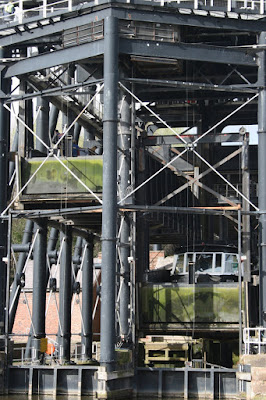

We watched the trip boat, Edwin Clark, go down the lift and narrowboat come up. Very interesting to watch the process. Tomorrow we participate in the experience by going down the lift to the River Weaver. Should be fun.

We picked up water at the disused BW yard and then tackled the Middlewich Big Lock. It was strange to cope with a wide lock, our first since leaving Braunston.
Middlewich Big Lock
The weather was fine and blustery as we left the town and the canal followed the valley of the River Dane. The section from Middlewich to Broken Cross is absolutely delightful. What's more it has a selection of excellent visitor moorings which are complete with rings. Just by Bridge 176 there is a really good picnic site and mooring on the offside which has some picnic tables and barbecue facilities.
Billinge Green Flash
We went through the flashes where BW once sank unwanted boats. Only one wreck appears visible. It looks like a token, or a gravestone for the rest of the fleet.
The weather got colder and windier as we approached Wincham so we moored up for lunch in a sheltered spot by Wincham Brook.
Brunner Mond factory straddling the Trent & Mersey canal at Wincham
As we passed the Lion Salt Works museum, the last salt factory to use use traditional brine evaporation, we noticed that they had a banner advertising that they were in the Restoration competition.
Lion Salt Works
We moored up for the night at Anderton on the 48 hour moorings and visited the Anderton Lift visitor centre. The whole experience of the lift and exhibition is impressive. Last time we visited Anderton, 2001, the visitors centre was not yet complete.
Anderton Lift in operation
We watched the trip boat, Edwin Clark, go down the lift and narrowboat come up. Very interesting to watch the process. Tomorrow we participate in the experience by going down the lift to the River Weaver. Should be fun.
Entrance to the Anderton Lift and Brunner Mond Chemical Works at night
Subscribe to:
Posts (Atom)