Showing posts with label Leicester Arm. Show all posts

Watford and Norton

Today we watched the Rugby Cup Final moored up near Weltonfield Marina. Shame about the result. Too much to hope that England would beat all the Southern Hemisphere rugby giants at one tournement.

Once the match was over we set off towards Watford. Our original intention was to try for Welford but that was plainly too much since we need to be home on Tuesday. We therefore winded below Watford Flight. The wind was very strong and it rained off and on. This brought down clouds of leaves which blew like a blizzard across the cut. Albert is a relatively heavy boat but we soon began crabbing. However, the winding hole at Watford of sheltered and "roomy" so turning was fine.

Watford Gap Services from the Canal

We retraced out steps to Norton Junction where we took on water. Mooring was plentiful at the junction but we decided to drop down one lock to use one of the more cozy moorings. Our intention is to go down the rest of flight tomorrow. So we decided to take a stroll around the fields along the Leicester Branch.

Obviously another enthusiastic Ruston owner 
(at Norton Junction)


Wallking along the moorings at Norton we discovered NB Trevor, a steam-powered narrow boat built around 1995. It is diesel fuelled which must make it more convienient to operate than classic steamers fuelled by coal. It appears that it has just changed hands from being moored on the Basingstoke Canal.

Steam Narrowboat Trevor


Diesel furnace and steam engine

Because of the canal's elevation the views around Norton are impressive. Today the lines of black clouds, and the sun occasionally breaking through, made this Midlands landscape look and feel very autumnal. Tonight we shall walk up to the New Inn where it should be warm and cosy.

Wool on barbed wire near Norton


An enormous Badger Set


An Autumn Cruise

An opportunity to go cruising arrived so we are heading north for a long weekend. On Thursday the weather was fine and sunny as we got ready to leave but we had seen the forecast which didn’t look good. The only problem with our start was Albert’s starter battery failed! We managed to quickly get a substitute from Baxter’s and we soon fired up the engine and were on our way.


Halloween Pumpkin

At home we had prepared a pumpkin (with two cat faces) and so were Halloween-ready! At Stoke Locks we met hire boat returning to Weedon so we paired up for the first lock. We then found another boat above the lock waiting to go up. After some adjustments we waited and went up the flight with a UCC hire boat from Braunston with a group of scouts from Essex. They were very helpful and made a good locking team. They stopped in Stoke and we carried on through Blisworth Tunnel finally stopped for the night at Bugbrooke, opposite The Wharf Inn, even though it was only 4:30 – it gets dark early these days. We just had to go into the pub for meal and drink.

Bloggers Derwent 6 moored at Heyford

Friday, the first day of November, was wet and windy. Overnight a plethora of leaves had landed on Albert’s roof. Passing through Heyford we found bloggers Derwent 6 moored up. At Furnace Wharf we disturbed a kingfisher who scurried along in front of us.

At Buckby bottom lock we dropped in to Whilton Marina café and had some delicious soup for lunch. A steady stream of customers came in while were there. Obviously a popular local venue.
Going up the Long Buckby Flight we met a few boats coming down which helped, but the lock mechanisms are so stiff the flight is never a pleasure.


We turned off up the Leicester Branch and moored up for the night near Weltonfield.

Crick Boat Show 2015

Visited Crick Boat show yesterday.Unlike previous years, ground conditions this year were good and the car parks were not a mud bath. We did, however, notice that vehicles in the exhibitors car parks were covered in a thick layer of dust - far easier to cope with!

Show boats busy with visitors

Although we arrived at around 10:30 the show was already filling up and by lunchtime it was decidedly busy. As usual, we started by touring the stands in the marquees. This year there were a number of stands promoting new marinas and, although there were stalls selling craft items, there was only a single stand selling antiques; perhaps reflecting the changing  tastes in boat styles - more chrome and less brass.

I visited the CRT tent whilst Maggie visited the craft tent. Richard Parry, the CEO of CRT, was in attendance alongside other staff. I took the opportunity of a lull in "customers" to introduce myself to Richard and have a chat. It is very refreshing that he attends such events and "muck in". We discussed the usual matters that concern boaters and I praised his open approach. Later on, whilst I was by the historic craft he wandered up to chat with Nick Wolfe whose boat, Aldgate, was on show. It appears that Richard recently had a trip with Nick who was offering another.

Richard Parry (CRT) and Nick Wolfe (in centre) discussing boat trips

The basin (marina) had a good number of boats on display but the dry standing area had only a couple of boats. The was a good number of wide beam craft that were packed with visitors. I hope that prospective buyers realise the limited range available for wide boats on our canals. If they don't  yet realise this then they soon will.  I suppose (hope) that most of the widebeams for sale will end up as liveaboards. Unless you are based on the wide Yorkshire waterways cruising even short distances will be difficult. The largest example on show was a 70 ft by 12.5 ft wide boat with a 90 hp engine hybrid engine. It was being sold as a live-aboard. It would not be able to navigate the 60 ft locks on some Yorkshire navigations. Moving on the Grand Union mainline would tricky and would require very careful planning, but it would provide luxurious marina living.

A large widebeam, complete with stern canopy and sunshade. 

Perhaps the most curious item of the show was the little model on the Rylard stand. The paint manufacturers had a small wooden model named Amelia Rose which are our granddaughter's names. Recently some friends of ours, knowing her names sent us a photo of a full-scale Amelia Rose narrowboat moored in Bath with a similar paint scheme. Unfortunately, the Rylard stand was busy so we couldn't stop to ask about the possible connection.

Mini Amelia Rose

Maxi Amelia Rose

Our Amelia Rose on a steam train


Canal, Cruises and Contentment by Austin E Neal


What a great title!

This is an early canal cruising book; published in 1921 and featuring cruises along the Ellesmere and Oxford Canals just before the First World War. The author lived near Derby and cruised the canals in his motor boats Hectic and Hectic Too. The book is from an age when motor boating was in its infancy. He is clearly enthusiastic (as the title suggests) about his pastime and keen to pass on his enthusiasm and knowledge others. The books contains chapters describing his two boats and their engine (note singular), the operation of locks, how to plan a cruise and the costs of operating a boat. He even has a chapter on washing up which some might find strange, but more of that later. Neal took along a camera when boating so the book has twelve high quality illustrations.

The book opens with a great passage describing the author's joy of canal boating:

"DITCH-CRAWLING" is what certain of my friends call it, mainly those who, living on, or near, the coast of this island, "go down to the sea in ships, and do business in great waters"

That these men "see the works of the Lord" I gladly admit; but the purpose of this little book is to point out, with all humility, that health, contentment, adventure (oft with a spice of danger), humour, faith, hope and charity, all in full measure, are to be found by he that possesseth a motor-boat and permission to travel "through, by, or over" the inland waterways of Merrie England.


As you can see he doesn’t hold back. You can also see that the term “ditch crawler” has a long history (over a century!).

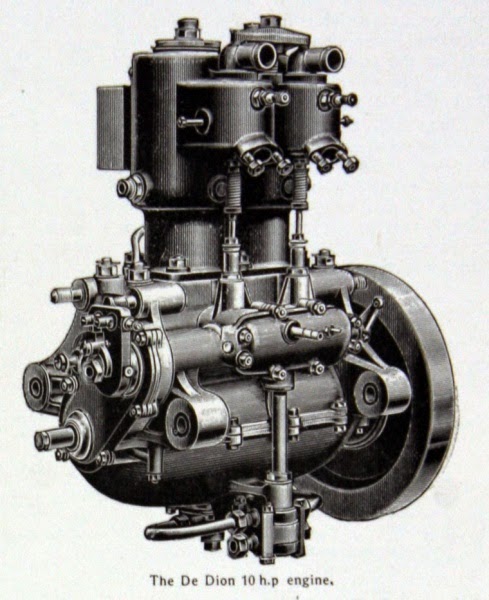
Neal spends a chapter describing his boats, the first was a converted ships lifeboat the second built to his specification in 1914 was 26 ft long with a 6 ft 6 inch beam. The beam was specified so the boat could pass through 7 ft locks and use “bumpers” (fenders) to protect the wooden hull; the draught was around 1 ft 6 inch because many of the canals were shallow. The engine he used was, in my view, a bit special. It was 1906 two-cylinder De Dion Bouton petrol engine rated at 12 HP and manufactured in 1906 for use in car. It had a form of magneto ignition augmented with a contact breaker. Neal moved the engine from Hector (1913) to Hector Too (1914). I searched the web and found an illustration that appears to fit Neal’s description. The engine had raw water cooling and a wet exhaust. Starting was by a handle and there was no electrical system on the boat.

De Dion 1906 Petrol Engine

The shadow of the Great War hangs over the book since the author wrote it shortly after the armistice and it is about cruises made just before hostilities began. Neal occasionally makes references to the Royal Flying Corp (RFC). At one stage describes flying over the Caen Flight on the Kennet & Avon. It appears that Neal was a 2nd Lieutenant in the RFC and his marriage in 1916 was recorded in Flight Magazine. He obviously kept a meticulous log, which formed the basis of the book, because he regularly reports details of his mileages and fuel use. 


One chapter, called “Under Way”, appears to describe an ideal day’s cruising on the Ellesmere (now Llangollen) Canal but it contains a curious description of double locks. It is possible that Neal was using artistic licence or possibly he was confused and recalled Hillmorton Locks on his Oxford Cruise. When cruising Neal usually had a male friend along for crew. The perfect day he describes includes cruising to Colmere. Along the canal they overtake several horse-drawn working boats.


So why a chapter on washing-up? The author states the obvious view (from what he describes as the fair sex) “just like a man to write a chapter about a job I can do in ten minutes”. He justifies the detail by explaining that the boat does not have an unlimited supply of hot water and has no sink. Neal appears to use canal water for cold water and heats it on a Primus Stove; two were kept on board. Neal washed plates and dishes in canal water followed a wipe with newspapers and perhaps some Vim. I realised when reading the chapter that we take stainless steel cutlery for granted. Knife polishing was an issue for Neal until he discovered “Lightning Knife Cleaner” which presumable is some form of abrasive cleaner that could remove corrosion. He also spends some time describing why fluted crockery is not a good idea since the fluting retains dirt. Although devoting a chapter to washing up was probably over the top, I can see, given the absence of facilities on his boats, why it was a particularly focus. A far cry from modern canal boats with all their facilities.


Neal eschewed newspapers (except for washing-up) while boating, so on August 4th 1914 he was unaware of world events and was enjoying boating on the Ashby Canal. That evening he got to just beyond Hawkesbury Junction. By the following afternoon he had reached Braunston and visited the village for supplies. Asking for a pound of butter he was greeted with “I might let you have half because I don’t know when will get more”. At was then that he discovered that the country was at war with Germany and. supplies of food suddenly had become very difficult because of panic buying. Crucially for his boating, petrol also became quite difficult to obtain because of government restrictions. Neal was told that it was required by the RFC. 

Neal passed through Foxton in 1914 on his way back home to Derby from Oxford


Neal ends his book by returning to his home near Derby from his 1914 Oxford Cruise with typical analysis of his log books. “380 miles, 189 locks, 40 gallons petrol and 9 ½ miles per gallon”. This was followed by another tribute to the charms of boating.

A charming evocative book from a century ago when life on the waterways and our country were very different. Although the book is quirky it is also has historical interest. Once I started reading it I just couldn't put it down. Copies are not particularly cheap, I paid over £30 for my copy, but it was printed on good quality paper with good binding and my copy is in excellent condition.

Crick Boat Show 2014

Crick Marina
Along with thousands of others we looked at the weather forecast for the weekend and decided that Sunday was the best of the three days to visit Crick. Arriving at Junction 18 we found ourselves in a long queue, some of it caused by congestion as the result of a breakdown on the M1 southbound carriageway, but most it due to heavy show traffic. It took a long time to negotiate the roundabout, where there was some confusion,  but eventually we got into an orderly queue along the A428. After one-and-a-half hours we finally got into the showground and then met the mud! The marshalling staff were doing a great job, because by midday the car parks were quite full, the mud meant that many cars, including ours, had to be pushed into a space.

A sea of mud

No wonder we didn't have much grip!

Getting into the site from the car parks was no problem since there were no queues. We celebrated getting into the show with a Cornish Pastie and sat and watched the Old Grey Dogs play bluegrass.

We then toured the pavillions and I went mad and bought a replacement Buckby can. The can from our first boat Bertie was decprated by Ron Hough and was given to me by Maggie for my 50th birthday, some 17 years ago. It has for some time sat alongside its larger "brother" on the roof of Albert. 

Bertie and Albert cans in better days (2008)

However, like its owner, it's beginning to show its age; its paint is peeling off. I think the very cold weather in spring 2013 must have really taken its toll. Our new can was from Sue Woodward from Long Buckby Wharf. We admire her work a lot and look forward to placing it on the roof next to our "Albert" can. Sue suggested that it may be one the last cans she decorates. 

Our new Buckby Can 

We toured the static (that is out of water) boats, looking at their steel work (some of which was somewhat less than perfect), and then visited the floating exhibits. The boats in the marina were creating a lot of interest with queues to go onboard.


Busy on the showboats

Among the showboats there were a few historic boats including President and Raymond. Kathryn Dodington from Stoke Bruerne was helping to display the Canal Museum's working boat Sculptor.

Kathryn on board Sculptor

 After bumping into a number of our boating friends, and visiting some more stands, we decided to take advantage of the Waterways World VIP pass and visit the Vintage Tea Room. Even inside the team room tent it was muddy, with the staff wearing wellies; they still managed to serve a delicious cream tea.  

Friendly service in wellies!

We were joined at our table by a couple and got talking about boating adventures, as you do. The conversation then wandered onto boat names. Since their boat had a Welsh name I proffered the trivial fact that as an Englishmen I had two years of Welsh when at school in Cardiff. As the conversation moved further on we discovered that I had attended the same primary school as the husband, just a few years apart: what a small world!

Camera Found!

I contacted CRT about my lost Canon SLR camera on Sunday morning. Working back over what had happened on Saturday, I thought that I may have left it on the bench outside the lock  keepers office by the top lock. We took on water there and I remembered sitting on the bench and thinking that I should take a photo, but the old brain cells failed to register if I did or if I didn't. What I clearly remembered was that I took a photograph of the working boat NB Cassiopeia earlier in the day and that all the way down the Watford flight of locks I had used my iPhone to take photos not my SLR.  

CRT came back to me later on Sunday to report that that the volunteer lock keepers who were on duty on Saturday were not on again until Monday and they couldn't say if the camera was found. I therefore "left it in their hands". Unfortunately, I got no response on Monday and I was only able to get through to the Leicester Section supervisor on Thursday morning. Later in the day I heard the great news that the lock keepers had found it on the bench on Saturday and they were keeping it safe in their office. What a relief! I didn't fancy the hassle of the insurance claim and I like my "old camera".

Today we travelled up to Watford Locks to collect the camera. Alison and Bill Root, who had found and kept it safe in their office, were on duty again. On Sunday, when we went down the flight, they were very busy so we had supplied them with cups of tea and some slices of Maggie's lemon drizzle cake whilst we waited our turn. The cake went down well then, so as a thank you, today we exchanged the camera for a a whole cake of the same. Many thanks to the lock keepers: All's well that ends well.

Making the exchange - lemon dizzle cake for camera
Lock Keepers Alison & Bill Root

Here, for the record, is the photo that I couldn't quite remember taking at the top of Watford Flight just before I lost the camera. The bench on the left, where Edward Winter is sitting, is where I left the camera.

Albert taking on water at Watford Top Lock

Here is the last photograph that I could remember taking!

Nb Cassiopeia near Crick 


Yardley Gobion (after nearly 6 months away)

We returned back to our home base at Kingfisher Marina on Tuesday after nearly six months away. We left Yardley Gobion in March travelling to Birmingham and then Llangollen before turning towards home. In May, on the way back we left Albert at Debdale Wharf so she could be taken out of the water, the hull grit-blasted and two-part epoxy resin applied. Unfortunately, the very cold winter delayed the construction of the new facilities so we had to wait for several months the work to be done. Luckily, we had no serious boating plans for the summer so we were able to moor at Debdale and enjoy taking Albert for a few local trips around an area we are not particularly familiar with.

With the work now done we took our friends Anne & Edward Winter along for an early autumn (late summer?) trip from Debdale. We rarely climb Foxton Flight because we usually do the Leicester Ring in the opposite direction. Even on a Tuesday there were a number of visitors watching boats and asking questions about the process of locking. We got up quickly and we were soon cruising in pleasant sunshine along what is a delightful section of canal. A number of kingfishers were spotted on the way.

Foxton Bottom Lock
Near the top of Foxton

   That night we moored up at Welford at the end of the arm and met up with Patrick and Pat from NB Diligent Too. Maggie & I met them in October 2011 when we went for an autumn cruise. They sold their share in NB Zenith and bought Diligent Too a 57ft Steve Hudson with a Beta JD3 engine. They are rightly very proud of her. We had good natter onboard Diligent Too followed by a good meal in the Wharf Inn, but by then the wet weather had really set in.

On Saturday we headed towards Crick in good weather and again saw several kingfishers. Diligent Too said goodbye and headed towards Market Harborough. Along the way to Crick we met a small nameless boat being poled along the canal. The engine had failed and the owner had taken three days to get half-way to Crick from Foxton. We couldn't discover why he had not tried to get the engine fixed at Foxton where there are plenty of services but he obviously had his reasons. He was having to use a pole, rather than bow hauling because of the mass of reeds and even small trees that are growing on the water's edge along this section. It would be impossible for a horse-drawn boat to operate along the Foxton to Watford section. We offered the beleaguered boat a tow but towing a small boat with little draught and a small rudder is not easy! It wandered across the cut from side to side so we only got about a quarter of a mile before stopping and casting off our tow. We certainly could not have safely negotiated a bridge.

We negotiated Crick Tunnel with no problems although a number of boats (about four) came the other way. When we got to Watford Flight in the early afternoon we discovered that there was only one boat going down in front of us but a long queue coming up. They were operating a six up and six down policy for the staircase so we had quite a wait. We took on water and had afternoon tea which we shared with the volunteer lock keepers who were working very hard.

Descending the staircase at Watford

We cleared the flight around five o'clock and in showers got to Norton Junction and turned south. All moorings at the top of the Buckby Flight were taken so we moored up on the moorings in the next pound. We have often moored here.

That night we failed to visit the New Inn because Maggie had already prepared a delicious chille con carne. We followed this by a game of Banagrams - we know how to enjoy ourselves - simple pleasures! The evening was however marred by the discovery that I had misplaced (lost?) my Canon EOS 400D. It appears that I may have left it at theWatford Flight because that was the last time I remember having it. 

On Sunday I contacted CRT about the camera and they told me that the lock keepers on duty on Saturday were not working but they would log the loss with their supervisor. We set off south and cleared the locks quite quickly. We then decided that we could make a Sunday lunch at the Narrow Boat at Weedon. We booked ahead because it is popular and arrived there around 12:30 in pouring rain. To cap it all the propeller became fouled just as we moored up and the engine stalled - not a good sign. I decided that going down the weed hatch to clear a prop in the pouring rain is not a good idea so I decided to leave it until the next mooring when better weather was forecast. Lunch at the Narrow Boat was very good and the service swift. We even had sweets. Edward particularly enjoyed the Banoffee Eton Mess! As predicted, the rain continued to pour for the rest of the afternoon.

On Monday got ready to continue our journey south. The idea was to make Stoke Bruerne. Although we could have considered making it home toYardley Gobion we decided that a night at Stoke was preferable to arriving at Kingfisher Marina late in the day. In my mind I thought that the fouled prop might take around an hour to clear. How wrong I was!

It quickly became clear that the prop was seriously jammed. A neoprene sheet had got caught and it was packed hard between the prop and the stern tube. It was so tightly packed that it felt like those rubber-based constant velocity joints (or rubber doughnuts) that were used on the drive shafts of Hillman Imps. Hacksaws, a pad saw and a divers knives had little effect. We went to Stowe Hill Wharf, just along the towpath, and they lent us a very sharp knife but that was little better. Eventually we discovered that a hooked Stanley knife, the type that is designed for cutting carpets, worked the best. The trouble was that this could only make small cuts and it was going to take a long time. Dave King on NB Jappa passed by and stopped to lend me his large prop cleaner that is produced by Bargee Bill. Unfortunately, despite its array of cutting surfaces this had only a small effect on the tangled mass of neoprene. Eventually we admitted defeat and for the first time ever I called in River and Canal Rescue. After a short delay they sent out some technicians from Heyford Fields Marina. They used a large sharp knife, and a pair of protective gloves, and after about 30 minutes they finally slashed away at the sheet sufficiently well to pull it free. They were, after all, a lot younger and fitter than us.

The offending neoprene sheet (foreground)

We eventually got going mid afternoon and had a three hour trip down to Stoke Bruerne. We were probably delayed about four hours by the prop incident. It was certainly the most difficult to clear of all prop fouling episodes we have had, including the plank caught above the prop of NB Penny from Heaven at Bascote.

The trip to Stoke was uneventful until we joined a line of boats going through Blisworth Tunnel behind a very slow boat. We slowed down to tick-over but that was still too fast and occasionally we had to go into reverse. Luckily all the traffic was going south since steering passed a boat coming the other way would have been tricky. Moorings at Stoke Bruerne were busy since the Village at War event had only finished on Sunday, but a kind boater moved his mooring so we could get in. One of the boats ahead of us in the tunnel, who clearly were novices and had difficulty steering, decided that mooring on the lock moorings was a good idea despite Mike Partridge having words with them (twice) and pointing out the large number of vacant moorings in the Long Pound (he was patient). I made a similar comment to them as I passed by on the way from buying milk at The Boat Inn (really!). Their response was they had safety issues - no comment. 

Air raid shelter underneath the double bridge - left over from the Village at War Event

On Tuesday we left Stoke Bruerne and dropped down the flight quite efficiently because a number of boats coming up. We were having a pleasant cruise near Grafton Regis when we found a (ex?) CRT work boat adrift and completely blocking the navigation. It had clearly come some distance in the wind. We pushed it to the bank and tied it on with the ropes it had. To call them ropes is a bit of an exaggeration, I wouldn't tie up a rowing dinghy with them. No wonder the boat broke loose. There was no sign of any chains, the usual way of mooring against sheet piling. 

Work boat blocking the navigation at Grafton Regis
We reported the problem to CRT. When they eventually come to retrieve their boat the operators will probably discover it was not where they left it and is pointing in the wrong direction. We got back to Kingfisher Marina in the early afternoon. 

A quite eventful short trip. The camera loss was a real disappointment but I will continue to chase up CRT to see if it has been recovered.  However, it is nice to get Albert back to her home base. 


Back in the Water

Albert is now back in the water at Debdale Wharf after the grit blasting, two-part epoxy blacking and the gunwales painted. We decided to go for a different gunwales treatment opting for a matt black with a "raddle-red" top surface. I shall have to polish the rest of the paintwork to match.

New gunwales treatment

Stern looking smart


On Friday we shall begin bringing Albert back to Yardley Gobion.


Hull Grit Blasted

Those who have been following my recent posts will know that we have been waiting for sometime for the new indoor grit blasting facility to come on stream at Debdale Wharf so Albert's hull could be taken back to base metal and an epoxy resin coating applied. Today was GB Day - Grit Blasting Day. The facility has been operational for a couple of weeks and today it was Albert's turn.

Dust Extraction equipment Debdale Wharf
In my last post about grit blasting I showed an image of the first boat through the facility. Above is an important part of the facility that is not normally in full view, the dust extraction equipment.

Albert with the cabin sheeted-up and hull without any bitumen coat
Albert went into the grit blasting bay yesterday and was treated this morning. I went up to Debdale this afternoon to inspect the hull once it was bare. It is revealing to see how she has stood up to almost 20 years in the water. Mike Goode took me over all the areas treated and, although there was some pitting along the water line, she appears to have stood up well. 
Bare hull sides with some signs of pitting
Anodes removed so area behind can be treated
Stern and Rudder

Tomorrow Albert moves into another bay in the building for treatment. The hull up to the rubbing strip will be coated with a two-pack epoxy resin coating and then the gunwales and counter will be painted. The red band on the counter will be reinstated but the paint will be applied over the epoxy base. There are also some extra jobs to be carried out whilst she is out of the water. The gas locker base and bulkhead will be treated with epoxy, because Albert has a wet locker, and we are having the bottom rudder bearing replaced since it has been groaning for a few years (like the crew!).