Showing posts with label Waterways Books. Show all posts

Down the River by H E Bates (1937-1979)

Having posted about the 1987 (50th) edition of this book, I began to look for earlier versions which I soon realised had wood-engravings for illustrations - I just love wood-cuts. It soon became clear that the first edition of 1937 had been reprinted in 1968 and 1979 and these editions used the same illustrations. Although I prevaricated (I like using that word), when eBay advertised a copy of the 1979 edition for less than £4:00 I couldn't resist buying another copy.


The hardbacked copy came with its original dust jacket complete with a charming illustration. The book boasts 83 wood-engravings; some full page, some included in the text and some decorating the chapter headings.


Lace Making


The book has a much more old-fashioned feel to it than my later edition and this version has paper quality which is surprisingly heavy gauge. It is altogether a better version printed and produced version as long you appreciate, as I do, the black and white engravings.

Title Page


Agnes Miller Parker's illustrations are extraordinary and invoke some of the same atmosphere as the Denys Watkins-Pichford work later had in Tom Rolt's Narrow Boat.


One example of just how "alive" the engravings are is the group of illustrations that accompany the story of Quintus that Bates relates when discussing the characters that lived near his home close to the Nene. It is a story of  the close (and somewhat ambivalent) connection working-people had with their pigs in the early 20th century. Bates' grandfather and his friend Quintus used to spend long periods admiring their pig and discuss her litters. Many in our Northamptonshire village also kept pigs; I bet they had similar discussions. The writing describing the characters and their views of life is first rate, but just add a few wood-cuts and it moves to another plane.


Quintus, pigs and piglets

According to the dust jacket, which contains a reprinted a review from The Observer published in 1937, "Very few modern books  have been so brilliantly illustrated". Over eighty years later I would certainly agree.


 Look out for copies of this edition from the usual on-line sources - you won't be disappointed and they probably won't be expensive.


Down the River by H E Bates

Having recently spent an idyllic holiday on the River Nene, I revisited a book we have had for some time. H E Bates, the famous novelist came from Rushden and wrote an evocative book about the rivers of eastern England "Down the River". There are several editions but ours is the 1987 (50th anniversary) edition which has illustrations by Peter Partington.


The book is based around two rivers, the Nene and the Great Ouse and is full of wonderful descriptions of the wildlife, flowers and people living alongside. 

Our copy has an inscription by Maggie's father Hugh, "To a family who have the luck to live between the Two Rivers". He was referring to the Chapter titled The Twin Rivers ad the fact that we live between the Two Rivers and we agree that we are lucky living in this area. With the inscription and its memories we particularly treasure this copy.  

Black-headed Gulls - we saw a lot recently near Woodford

A Lock


Lace-maker

There are chapters on fishing, wild flowers, water mills, and otters but unusually there is an interesting chapter on lace-making. The villages in South Northamptonshire have a long history of lace-making and we live opposite a row of cottages that was a lace making "factory".  We can relate to the stories Bates relates about the craft because our village has similar. The history of how the art arrived in our part of England is retold and this is important. .

There are a least two other editions with first edition, published in 1937, having wood engravings by Agnes Miller Parker. However, the 1987 edition is widely available through the usual second-hand book sellers for around £12.  Its a good read and the illustrations of the edition we have are charming.

Researching for this post has convinced me that we must also get a 1937 edition because it is illustrated with wood cuts - I love wood cuts.


IWA Rally Milton Keynes 1985

I rarely discover collectible waterways books on eBay, probably because the ones that I wish to own are now more rare. That is probably why leaflets and brochures related to boating sometimes catch my eye. The other day I saw a souvenir brochure from the 1985 IWA National Rally for sale. The rally was held during the August Bank Holiday on the Grand Union close to the centre of Milton Keynes.

IWA National Rally Brochure 1985 Milton Keynes
Location of the photograph is Waterside, Peartree Bridge, Milton Keynes

Living close to Milton Keynes, and remembering that we visited the rally, I couldn't resist purchasing it. In those days we weren't boat owners but we were interested in canals; living close to the Grand Union we had visited Stoke Bruerne a few times. I must admit I cannot remember much about our visit to the Rally, but I did remember the approximate location of the site and viewing the boats moored up. We were certainly not intending to buy either a holiday or a boat, they were both well out of our league, but we did have a good day out.

The National Rally at Milton Keynes was held at a time when the New City was expanding rapidly and Blisworth Tunnnel had just been reopened after it rebuilding. There are many references in the brochure to the relining of the tunnel. It was therefore a time of modest optimism. The brochure includes an interesting section reflecting on the famous/infamous first IWA Rally at Market Harborough in 1950 where divisions in the newly-formed IWA came to the fore.

Lord Lucan and John Knill judging the best decorated working boat at Market Harborough in 1950

Commercial input into the 1985 rally was significant. The trade show directory featured eighteen boat builders including well known names such as Peter Nicholls, Calcutt, Colecraft and Springer. Of particular interest to me is the advert from K E Jones Steam Cruising. Keith displayed his steam boat Firefly and around nine years later he was responsible for the installation of the Ruston engine in Albert.


South Midland Water Transport, were based locally, obviously brought their wooden working boat Hesperus to the rally. It was formerly owned by Lord Lucan (father of the infamous holder of the title), who took her to the 1950 rally (above). For many years we saw her around our local waters - slowly deteriorating.

The site of the 1985 rally is also interesting. It is just north of Bridge 82 and near Campbell Park. This is close to the designated connection to the proposed Bedford to Milton Keynes Link and just north of the new marina that is being constructed close to the city centre. The maps below are from the rally brochure and from Google where I outline in red the location. Today the rally site is mostly occupied by the Gulliver's Land attraction.


Rally Site Location as shown in the brochure (1985) and Google Streetview (2019)


The "Events Bowl" shown on the right of the brochure site plan is still a noticeable feature - you can see it well on Google Street View. The circular area near Willen Lake hosted a Barron Knights concert on the Saturday evening. We didn't attend, so I can't report on how well attended it was, but it was a modest venue. This is unlike the National Bowl in Milton Keynes where earlier in the year U2 performed in front of 50,000 and they were supported by REM, Billy Bragg and The Ramones (what a line-up!).

Whilst discussing numbers, the attendance at the rally was nearly 30,000 people with 514 boats present.

I leave you with this thought; next year it will be 70 years since the first rally at Market Harborough and the 35 years since the Milton Keynes Rally. I think the changes in such boat gatherings in the last thirty-five years have probably been greater that in the first.


William Bliss and The London Mercury 1930

I recently received a mail from a contributor to a blog on fantasy fiction and the supernatural. They recently ran a piece on William Bliss and added it to their site because of the waterways connection and because Tom Rolt and Robert Aickman both wrote ghost stories. I can recommend their post.

It appears the Wormwoodiana bloggers first established a connection with William Bliss via an article published in the interwar literary journal, The London Mercury, on the English Waterways. Not being familiar with this article, I got hold of a copy of the magazine and discovered that the article was effectively the first chapter to Bliss's first canoeing book - The Heart of England by Waterway that was published three years later. Reading through the article bolstered my enthusiasm for Bliss's evocative writing.


The London Mercury was edited by non other than J.C. Squire who accompanied William Bliss on a canoe trip and reported it in Water Music. In the magazine was a wonderful woodcut that related to waterways. I couldn't resist including here. Note the great title!


An Image of William Bliss

The great writer on canoeing and waterways William Bliss was reluctant to have his image published. In the frontispiece of his book Heart of England by Waterways, published in 1933, he is shown head down in a canoe presumably reading some notes. However, I have recently managed to access a likeness.

Frontispiece of Heart of England by Waterway, 1933 
Having discovered recently that there is more interest in Bliss than I thought, I decided to revisit my earlier research on his life but use my recent subscription to the British Newspaper Archive to see what it turned up. In the archive I managed to find out more about his professional life in the law, and I even found an announcement for a lecture he gave promoting his book Heart of England by Waterways, but best of all I was able to find an article in the Daily Mirror about the canoeing events at the 1948 London Olympics and the attendance of William Bliss.

The canoeing events for the first post-war Olympics were held at Henley-on-Thames and the August 1948 article in the Mirror was written by their celebrated columnist William Connor  or "Cassandra". In his article Connor used 84 year-old Bliss as representing the antithesis of the modern canoeing  racing. The title of the piece is "A canoe is for canoodling says Old William". Bliss (Old William of the title) was of course more of a paddler than a racer and Connor has him complaining that the racing they were both watching was "madness". He is quoted stating that "water can be drunk - by those who have a taste for that sort of thing. It can be swum in, fished in, and rowed, sailed and paddled upon - especially paddled upon. But this is madness". In common with such lighthearted articles of the time the article is illustrated with cartoons of some of the characters involved in the narrative but the main cartoon is of Bliss.

William Bliss cartoon, Daily Mirror, August 12, 1948
 
Bliss also appears to be a dapper dresser with a button hole- every inch the retired London solicitor? The hat in the cartoon also looks similar that worn in the photograph above. The article reveals that Bliss had watched Henley Royal Regatta of sixty-four consecutive years, which given his alleged distaste for racing canoeing appears slightly mysterious but then Bliss appeared to think canoes were reserved for other matters - "to go where others become stranded, shoot rapids and explore lovely backwaters" - the article quotes, and as the title of the article suggests, Bliss thought they were "to make love in."

Bliss died just over a year after the Mirror article was published following a car accident near his house in Buckinghamshire.

William Bliss Canoe Trail

Until very recently I wondered if I was one of only a handful of enthusiasts of the work of William Bliss, writer on canoeing and the inland waterways. If you have followed my blog for some time, you may recall that I posted a few articles around 2013 about the books of William Bliss and also his canoeing with Sir John Squire. I also recently mentioned Bliss to the canoeist and CRT writer in residence Jasper Winn but his response led me to believe that William Bliss is still an unsung hero of the waterways.

But blow me down (with a feather), I have just discovered by browsing that things have moved in the world of William Bliss and canoeing. A group of canoe enthusiasts has developed a long-distance (862 mile) canoe trail along the inland waterways of England and Wales in the name of William Bliss and have a web-site and Facebook page related to journeys along the trail.


I was really pleased to find the trail being advertised, and fascinated to discover that some canoeists had completed the marathon in 2017. It was also interesting to find a group had completed the route back in 1993 at the time of the bicentenary of British Canals and posted some old photographs of their journey.

However, it got really interesting when I read the web page relating to William Bliss on the official site. It contained, word-for-word, my text from a post on Bliss in 2013. The Bliss Trail site even used the image I posted of the dust-cover of my copy of "Canoeing".

Now I am pleased that the world of canoeing has become more interested in William Bliss and pleased my blog has been read. Although my blog is not copyright it would have been polite to have been given an acknowledgement or perhaps even a link.

Water Ways by Jasper Winn

Back in June we noticed that the nearby Buckingham Literary Festival was featuring a talk about the canals by Jasper Winn who CRT had appointed a "writer in residence". A residency on over 2,000 miles of waterways is perhaps an interesting concept, hence my use of quotation marks. Whilst on the subject on syntax, the use of  two words for the title of his book is interesting - perhaps helpful for internet searches. Maybe it also gives more of a sense of routes and roaming. Jasper did a lot of wandering during the year by foot, kayak, bike and boat - the book's subtitle claims a thousand miles.


The book festival event was early on a sunny Sunday morning and it consisted of an illustrated talk  that was essentially a snapshot of the book's contents. We found the talk Jasper fascinating and enjoyably familiar; he covered a lot of ground. It was also obvious from the questions posed from the non-boating audience that they were also enthused by the presentation. I just had to purchase a copy of the book and have it signed.


During the talk I wondered if, being a canoeist, if Jasper was aware of the books William Bliss. After the talk and the signing, I chatted to him about this. He appeared to recall the name but there is no reference to Bliss in the book.

Unlike, for example, Terry Darlington's books that consist of a story of a voyage, Jasper's book not only reports on a series of journeys along canals, but it weaves into the chapters all the history of canal construction, the story of canal people through the centuries, the remarkable story of how our canals were saved, and the modern canal scene. Jasper previously wrote about his journey by kayak around Ireland and he uses this mode of transport on several journeys, but notably along the Kennet & Avon. As an example of how the book is constructed, he describes a walk along the Huddersfield Canal but combines it with a discussion on the lives and roles of navvies and the history of Standedge Tunnel.
The book is clearly very well researched and illustrated with a good selection of historic illustrations and contemporary images. It is not a stuffy text and is amusing throughout. I presume CRT must have made resources available but there certainly no evidence of them being involved editorially in the book; the  chapter on live-aboards is evidence. The book covers all you could expect to read about today's canals putting into context how and why they survived and their impact on modern society. It even has a useful glossary of terms, a bibliography and lists of relevant music, film and websites. A great read.

I did note one small editing problem on page 214. The text states "I cycled through Bruce Tunnel".  Jasper clearly kayaked through the tunnel, after all there is no towpath. Mind you, in a book of this type with over 300 pages production slips like this are inevitable.

The see that Water Ways is available from the usual on-line outlets and also available as a download.


Locomotive with Tom Rolt Connections

On Sunday we had a special day on the Severn Valley Railway celebrating the 70th birthday of Mike Corbett a friend who was involved in the recent restoration of the Flying Scotsman. This involved a leisurely lunch onboard a train pulled by a Great Western 0-6-0 pannier tank. Having lived in Cardiff during the last days of steam, these little engines are very familiar to me since they even carried me to school.

GWR 0-6-0 pannier tank 7714 on the Severn Valley Railway at Kidderminster

The engine on duty to pull our train was 7714. It looked smart in its British Railways black livery, but I was particularly struck by the shiny brass plate on its frame. The plate indicated that the loco was built in 1930 by Kerr, Stuart & Co Ltd., of Stoke-on-Trent. This rang bells with me since I knew that Tom Rolt had been apprentice at Kerr Stuart and his uncle Kyrle Willans was chief development engineer. Willans was at that time also the owner of Cressy the boat Rolt was later to own and make famous in his book Narrow Boat. 


Makers plate

The next stage was to check the chronology to see if 7714 was being built when Rolt was working for Kerr Stuart. A quick check of Rolt's autobiography Landscape with Machines revealed that he was indeed working at the Stoke factory in 1930. Rolt reports that "twenty-five new six-coupled pannier tanks were being built for the Great Western Railway" and points out that the paint shop were not happy with the specification in the contract set by GWR and that it caused "head-shaking".

So there we have it - a preserved locomotive built in the Kerr Stuart factory (California Works) whilst Tom Rolt was serving his apprenticeship. I am sure given Rolt's connections with both railway preservation and canals, he would have been pleased.

GWR 2-8-0 locomotive 2857 crossing the Victoria Bridge over the River Severn near Arley
(courtesy Mike Corbett)

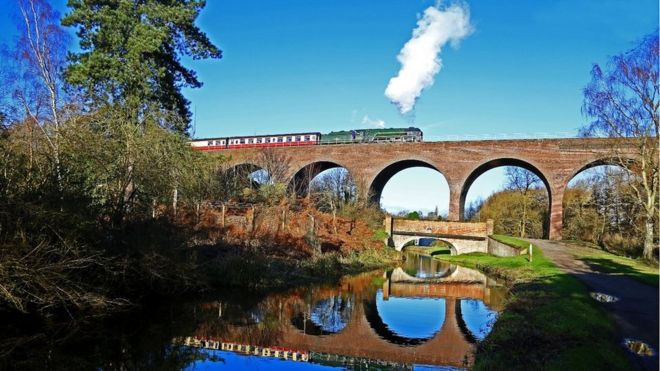
What a shame the River Severn is not navigable up this way. However, it is still possible to navigate under the Severn Valley Railway on the Staffs & Worcestershire Canal near Kidderminster where the railway crosses via the Falling Sands viaduct.

The Falling Sands viaduct
Falling Sands Viaduct 
(courtesy Severn Valley Railway)


Now a Crazy Canal Book Price Drop!


It appears that the seller of the crazy-priced maps on eBay is now offering one with a staggering price drop of £11,895.36 and the postage is free! It's now priced at a realistic £2.80.

Unfortunately, they are still offering one map at £11,898.16 and it is listed as being the last one. On ABEBooks they still have two for sale, both priced at £23,790.92 !


Crazy Canal Book Prices!

I wonder if other canal book enthusiasts, or for that matter other collectors, have noticed that occasionally postings on book selling sites and eBay asking stupid prices for what are mundane publications.

I like to buy the rarer, and occasionally more costly books, so I sometimes list items by "highest price first". This avoids wading through page after page of ordinary magazines. Sometimes historic canal maps and parliamentary acts and very rare books are offered; such as early editions of Hassell's Tour of the Grand Junction which go for around £3,000. However, sometimes the list includes items that are plainly priced incorrectly. This can sometimes be attributed to incorrectly using a currency conversation, but sometimes there doesn't appear to be any logical reason.

Today I found an example which appears to defy all logic. The GEOprojects series of maps are practical modern folded paper maps. Their map covering the Caledonian Canal is currently unavailable from the usual retail suppliers such as Waterstone's and Blackwells and the IWA shop doesn't have a copy. When available the map was priced at around £4.75. The next usual route for purchase would be on-line through Amazon but they don't have a new copy available.

However, they do however have three used copies. Now you might expect them to go for around £5 but you would be mistaken. A second-hand book seller is actually offering them through Amazon for £11,894.78! They are also available at the same price through eBay where postage is available for only £2.50.

Now I thought that was the limit for overpricing for this item until I found the same maps were available via ABEbooks from the same seller for whopping £23,2790.92 with £2.75 postage. Not a bad mark-up for a modern folded map that recently was on on sale for less than £5. Finger trouble when posting - who knows? I hope nobody clicks on them by mistake when on-line shopping!


The same seller also has a historic 1910 map of the Caledonian Canal offered at £8.29; now that looks a bargain in comparison!


An Inland Voyage - Robert Louis Stevenson Part II

With Robert Louis Stevenson's later travelogues and novels becoming very popular, interest in "An Inland Voyage"  continued over the years. It was probably inevitable that fans of RLS would want to follow in his footsteps, or in the case of An Inland Voyage the wake of his canoe, so a late twentieth-century edition of An Inland Voyage was published that provided readers with itineraries that can be followed.

Cover of the 1991 illustrated edition published by Cockbird Press

The version was published in 1991 with travel notes by Andrew Sanger. It includes biographical details and four detailed itineraries that suggest hotels where the traveller may stop along the route. The edition also includes many helpful annotations and some delightful water colours by Michael Reynolds.  Material not in the early nineteenth century editions is also included. There is a chapter where Stevenson and Simpson travel south of Paris along the Loire (on foot). It was on this section of their travels that RLS first met Fanny Osbourne and her son eight-year old son Lloyd. Fanny was to become Stevenson's wife and Lloyd his long term collaborator. A preface by Lloyd Osbourne is included in the edition along with a charming note by Fanny Stevenson.

The itineraries and the illustrations are all based on the journeys through France, not Belgium. The section through Belgium is dismissed in the introduction by Sanger as being "not ideal boating country" and the Willbroek Canal as being "miserable, polluted and ugly". The four travel itineraries put forward by Sanger start in Maubeuge, with three north of Paris and one south. 

A typical itinerary map from the 1991 edition

The additional section south of Paris includes a passage where Stevenson, referred to as Arethusa after the name of his canoe, was arrested at Chattillon-sur-Loire. He was travelling alone at that time and was waiting for Cigarette (Simpson). He was accused by the local "Commissary" of being a German spy. Stevenson's incarceration lasted some time until his compatriot Simpson arrived. The authorities appear to have been impressed by Simpson's appearance. Unlike Stevenson, who was an eccentric dresser, Simpson was a "man of an unquestionable and unassailable manner" and his passport referred to him as a Baronet. The authorities were therefore impressed and soon released Stevenson. 


It is interesting to note that this modern edition is now over 25 years old. Much of the information added by Sanger is probably now not current. Nowadays such information would probably be consigned to blog-site, missing the charming illustrations. It illustrates the point that, to a certain extent, all books are "of their age".

Many copies of this modern edition are available through the usual web sites. Most are priced at less than £3 - who could resist that?

An Inland Voyage - Robert Louis Stevenson Part I


I was browsing the web a few of weeks ago and came across “The Canal Boatmen 1760-1914 by Harry Hanson”; it turned out to be a good buy and one of my most fascinating recent reads, but that is another story. On the title page of Hanson’s erudite book, it was based on an MA thesis, was a quote which immediately caught my eye:

“There should be many contented spirits on board, for such a life is both to travel and stay at home …. and for the bargee, in his floating home, travelling abed, it is merely as if he were listening to another man’s story or turning the leaves of a picture book in which he has no concern”

Great quote – but by whom – Robert Louis Stevenson, An Inland Voyage, 1878

Robert Louis Stevenson

At that point I was hooked – I just had to know more of An Inland Voyage. I quickly found that it was Stevenson’s very first book and well before Treasure Island. It chronicled a canoe voyage with a companion down the rivers and canals of Belgium and Northern France. RLS and his friend Sir Walter Grindley Simpson took a 200 mile journey in 1876 in two canoes named Arethusa (RLS) and Cigarette (WGS). 
Sir Walter Grindley Simpson

The canoes were wooden and it appears they were capable of being moved by sail as well as paddle. Although their trip was in the summer, their journey was plagued by bad weather. In common with much similar Victorian literature, RLS does not use given names in the book and refers to himself and Simpson by the names of their canoes.


I obtained my 1896 eighth edition in good condition from a well-known second-hand book web site and paid less than £10. I read it quite quickly, enjoying the narrative but I found, like some other modern commentators, that it is quite impenetrable in places. At one point I read over two pages before I realised I hadn’t a clue what was happening!

So is this book is a travelogue? – well no; it's more an evocation of boating as a way of getting away from everyday life. It’s full of philosophy, charm, wit and the occasional flight of fancy. Meeting local people is a continuing feature of many chapters. It is definitely short on detail and therefore not very helpful for others following the same route.

One or two sections really impressed me and made me feel that I was alongside the canoeists (in the rain). In particular I enjoyed the wonderful chapter describing the pair meeting a group of enthusiastic oarsmen from the Royal Sport Nautique club in Brussels. The travellers were so grateful for their help on a wet night but they found their hosts enthusiasm for rowing, and sport in general, so overbearing that it caused them to leave early next morning to avoid disgracing themselves at a promised rowing event. The RSN 1895 club is still operating today and appears to be continuing the traditions of friendship and enthusiasm discovered by Stevenson and Simpson.


Apart from the philosophical aspects, which could be termed Zen and the Art of Canoeing (borrowing from the title of the 1970s cult novel), only a few passages will stand out for the boating enthusiast. One passage early in the book particularly caught my eye. It was when Stevenson describes passing a train of boats pulled by a chain-driven steamer on the Willebroek Canal which runs from Antwerp to Brussels. He describes with wonderment how the steamer and its train moved “along the water with nothing to mark its advance but and eddy alongside dying away into the wake”. He must have been familiar with the turbulence created by paddle-steamers. This is a fascinating insight into the importance of the wide open waterways on Northern Europe and how technology was beginning to make its impact in the 1870s.

Warfare is another recurring theme in many passages in the book as the Franco-Prussian war had recently finished with government of France falling. Stevenson reports on several French communities where there was a significant military presence. Reading some sections, I also couldn’t help thinking about the horrors of the forthcoming World War that was to hit this part of Europe a few decades later; a lot of the towns mentioned in the book are unfortunately familiar as WW1 battlefields.

I will finish this post with a quote from preface to the first edition. The young writer Stevenson states:

“It occurred to me that I might not only be the first to read these pages, but the last as well; that I might have pioneered this very smiling tract of country all in vain, and find not a soul to follow my steps”

I understand that the book was not an immediate success, although he was paid £20 by the publisher, but it was the begining of a stellar writing career. There are many following his footsteps today as I will relate in another post.


Keep Left?


I had taken for granted that, except for special circumstances, boats PASS ON THE RIGHT (i.e. port-to-port).  This accords with the international rules of navigation and all current and recent guidance confirms this (e.g. from BW, CRT, IWA, EA) .

I had also assumed that this guidance was both universal and historic. However, I recently obtained a 1950 1st edition of the Inland Waterways of Great Britain & Northern Ireland by Lewis A Edwards and a section in the book led me to consider that some navigations required boats to PASS ON THE LEFT, perhaps as recently the nineteen-forties.

In the appendix to the book there is a note on Navigation Hints for Pleasure Craft. The note provides interesting insights into the days when our canals and rivers were first and foremost commercial highways. It provides lots of helpful advice on how to ensure working boats are not impeded; one can easily imagine the frustration of working boatmen with amateur crews, particularly at locks.  

Concerning boats passing, the advice is clear:

"On our rivers, and over most of the canal system, ... the passing rule is KEEP RIGHT; but there are exceptions to this such as the Worcester & Birmingham Canal, where the rule is KEEP LEFT"

The writer goes on to advise pleasure craft crews to ask boatmen. This came as a surprise to me since I had not read anything similar. 

The book is edited by Lewis Edwards who is credited as being Honorary Secretary of the Inland Waterways Association. It largely consists of factual material but the note about navigation was written by none other than Tom Rolt. The advice originally came from a leaflet originally published by the IWA. Tom Rolt was Honorary Secretary of the IWA until 1950, the year of the book's publication and Lewis Edwards was in the process of taking over his role. Later in the year considerable changes occurred in the IWA with "Civil War" breaking out. Rolt and others resigned.  

Some questions arise from the note:

Is there other evidence for this navigation advice?

Does the particular reference to the W & B come because Rolt was moored up for several years at Tardibigge? 

Did canal amalgamation, and ultimately nationalisation, bring uniformity or were there other reasons? 

When did uniformity occur?


I can recommend the book as offering insights into an interesting period of waterways history; on the cusp between commercial and leisure boating. It is easier to navigate (pun intentional) through its chapters to find a particular waterway than Bradshaw, which annoyingly groups navigations by their ownership (mostly railway companies) and not by geography or given name.  My copy was not expensive, obtained via eBay and is in good condition.

The Great Towpath Walk - Brian Bearshaw

Long time since I posted. I've been busy on various non-waterways projects and the months just rolled by. However, I was still active reading and buying waterways books so you can expect a few such posts in the near future - and we do intend boating during the summer.

Cover featuring Foxton

One of my recent finds followed on from  my post on The Towpaths of England by Brian Bearshaw. You may recall that I noted that in that book some individual canal-side walks were featured but the centre of England appeared neglected. This book is different and consists of one long walk through the centre of England from London to York. It therefore covers many of the canals that were "missing" from his earlier book including the Grand Union. I say earlier because this book was published in 1988 following Towpath Walks which came out in 1985. This book follows the author walking from central London via the River Thames and then along the Grand Union to Leicester followed by walks alongside the Rivers Soar, Trent and Ouse.

Route of the walk (back cover)

The walk was obviously a considerable undertaking requiring careful planning. Each chapter is basically one day's worth of walking - making this a 16 day walk. As with Towpaths of England, this hardback book is beautifully illustrated with stylish black and white drawings by David Chesworth.

A typical map for a day's walk

The text is more interesting than Bearshaw's earlier book with more content related to the people he met on the way. I suppose that is more of the nature of long distance walking as opposed to walking on single days because overnight stops are required. Most evening stops are only alluded to in the book and it is not that easy to work out where the author spent each night, although there are clues.

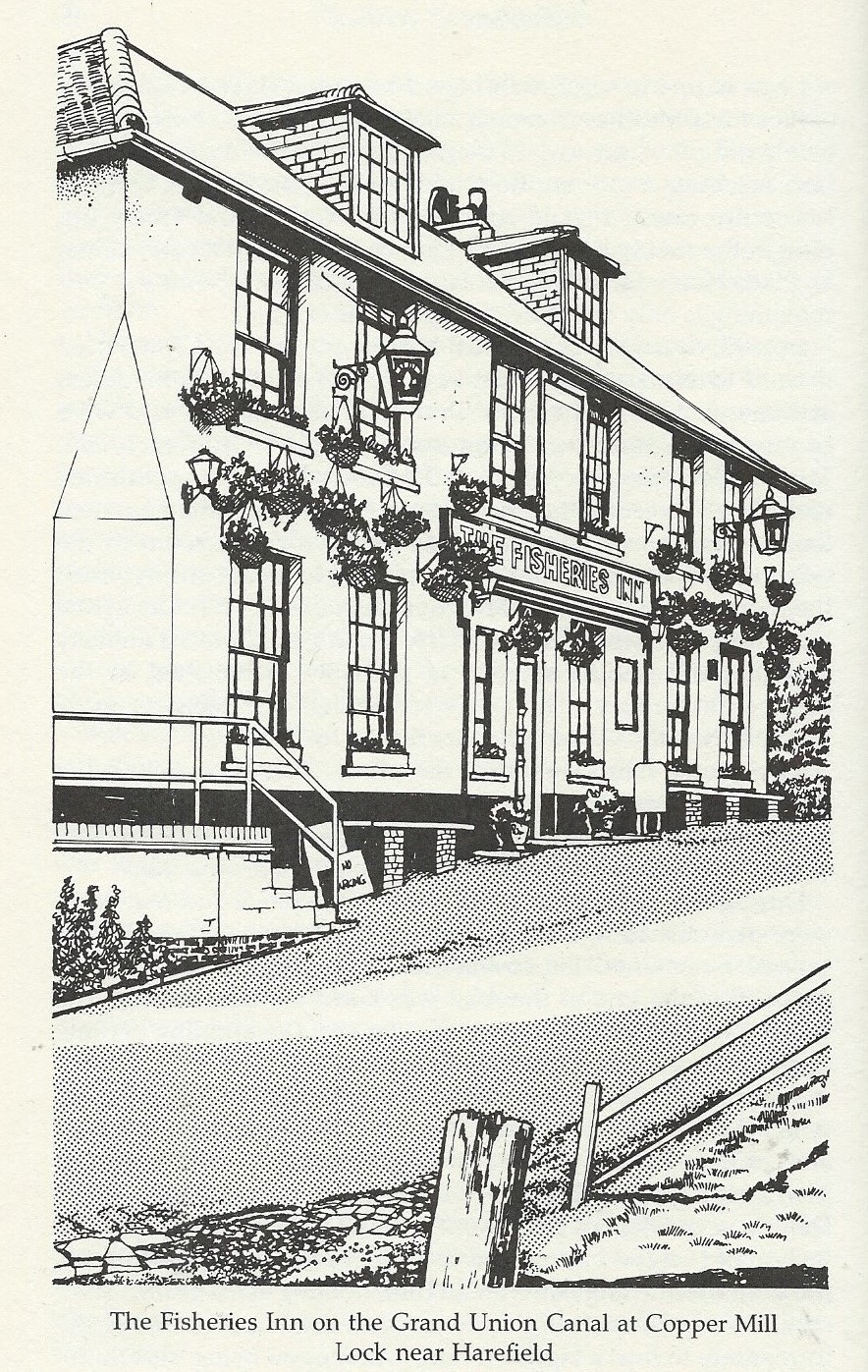
Copper mill, Harefield 
The inn is now The Coy Carp

Windmill in Milton Keynes

On most occasions Bearshaw was fortunate with his overnight stops but on one occasion his source, presumably a guidebook, let him down badly. This incident was of particular interest to me because firstly the location is very well known to us, but secondly the way Bearshaw recovered from his predicament. He was weary, and it was getting dark, when he met Brenda Walker who ran Anchor Cottage Crafts at Long Buckby. We knew Brenda in the 1990s when we often stopped at her shop and browsed her wares. We also knew her son who lived in our village. Bearshaw was obviously so grateful for being taken in for the night by Brenda because she not only gets plaudits for her breakfast but she also is the only character he meets that is mentioned by name - she obviously made an impression on him. Strangely, she doesn't appear in the books index which only lists historical characters.

River Soar
I found it a good book to read during the winter evenings. Although thirty years-old most places mentioned are still very much the same so it still has relevance for today's boaters. Making comparisons, particularly with some of the boats illustrated is a fun pastime. It is particularly interesting to note the changes that have occurred on the River Trent; when the book was written it was still a busy commercial waterway.

River Trent scene

Bearshaw makes a number of off-towpath diversions during the walk, notably along the Trent and at York but his focus remains the towpath and the history of the areas passed. The River Trent chapters certainly opened my eyes to some of the historic areas that the river traverses.

Goole
York

When reviewed Towpaths of England, I likened it to a guidebook and noted they didn't produce books like that any more. The Great Towpath Walk is is less of a guidebook and more of a travelogue and they are a very popular form of non-fiction. I can just imagine Michael Palin taking this journey along with a camera crew and writing a spin-off book. Of course today's travelogues are usually gloriously illustrated coffee-table books with colour photographs and not modestly sized books with hand-drawn monochrome illustrations, but therein lies its charm. I suggest you look out on the usual on-line suppliers for a copy which should be available at modest cost.