Long Buckby

In the wake of the Covid-19 lockdown we finally managed get away on Albert because staying overnight on boats is now allowed. We are going to take a cruise along the South Oxford which will be interrupted by a short period at home to celebrate our landmark wedding anniversary. The weather was dry as we left Yardley Wharf on Thursday but it became damp and then wet as the day wore on. We went up the Stoke Bruerne flight with a hire boat from Gayton and were assisted part of the way by a pair of CRT volunteer lock keepers.

Our first post-lockdown locks

At the top lock I was taken aback a little when I found a swan family coming out of the lock as the gates were opened. It appears that boaters were being encouraged to try and keep the family in the top pound to avoid potentially lethal confrontation with another more aggressive family further down the flight. The operation of retaining them in the lock was quite an exercise – carrot and stick but with duck food.

Locking Swans

We had a good trip through the tunnel where it was a relief to get out of the rain. We eventually moored up just north of Gayton Junction at one of our favourite spots.

On Friday the weather was much better. We popped in at High House Wharf to discuss a possible paint refresh on the grey colour of our roof with Colin Dundas. The traffic on Thursday had been light but around Weedon more boats were on the move. We reached Whilton just after lunch, picked up some supplies including some gas and then went up the flight with Ragweed a hire boat from Weedon. The couple hiring the boat were from Kent and admitted to being relative novices. However, they handled the boat well and together we made good progress up the flight aided for most of the locks by a steady stream of boats coming down. We moored up just below the top lock and Ragweed joined us. Opposite was a delightful garden and we got talking to the owners who are showing it as part of the National Garden Scheme. It appears that the scheme will operate by appointment under the current Covid-19 regulations. We had a long chat because it turns out we have mutual friends.


Geoff is a retired railway signal man and Sue is a talented canal can painter keeping the Buckby can tradition going. One of the cans on Albert is Sue’s work – we purchased it at Crick Boat show a few years ago. The garden also boasts the top part of a signal from Harpenden which works, a low-level shunting frame signal and a streetlight from Droitwich circa 1930 complete with operating original bulb.

A Roses but not Castles Tray

Long time readers of our blog may recall that I posted about the origin of Roses and Castles decoration way back in 2008 when I came across a blue underglaze plate with a scene reminiscent of the traditional Roses and Castles. Having read Tony Lewery's two books on canal boat painting (Narrow Boat Painting and Flowers Afloat) I have been aware for some time of his hypothesis that the inspiration for the style came from not only Victorian pottery decoration and but also Jappaned goods. I was therefore delighted when the other day we got a present of a decorated metal tray that our daughter Lucy had picked up at antique fair in West London. She described it on the phone as being "a bit like Roses and Castles". When we got it we found it had all the hallmarks of the traditional Roses and Castles style - but minus the castles. It is probably what is described as Toleware.

Our painted metal tray

The tray is just over a foot in diameter and has a dark green ground that is similar to many of the shades used on narrowboats. The flower decorations are very similar to that found on traditional canal boat decoration and the roses in the centre are painted are clearly painted in the same manner with confident sweeping brush strokes. The perforated edge to the tray shows signs of gold paint. We have no idea as to its age (or even its country of origin) but we think its a very pretty item. If could be old, that is Victorian, and this would certainly reinforce the theory put forward by Tony Lewery since the painting technique is so similar.

.


First Trip of the Covid-19 Crisis


So with CRT advising:

"From today, Weds 13 May 2020
You may undertake short boating trips only from today – avoiding use of locks and any staff-operated structures if possible – providing, as per current government guidance, you do not stay away from home overnight and return to your home mooring (where you have one)."


we managed a short trip out for the first time since I don't know when.

 In fact with other pressures on our time pre-crisis this is the first cruise of the year. Albert need a bit of fettling after the winter before we got out of the marina by midday.

We managed it all the way to Cosgrove Lock and back but took the opportunity to drop in at Baxters at Yardley Wharf to use their services (pump-out and diesel). The weather was just glorious and ideal, it made us wish for a long trip.

Grassy Towpath near Yardley Gobion

Met some neighbours from our village walking a circular route and had a socially distanced conversation. There were a couple of other boats moving but understandably it was quite. We must do more of this!


Old Stratford Wharf

We pass along Watling Street almost daily since we live just north of Stony Stratford. I am familiar with the route of the Buckingham Arm of the Grand Junction and the Old Stratford Branch in particular. I often sit at the traffic lights at Old Stratford in queues of traffic thinking of the boats that used to pass under Bridge 2 (the so-called Old Stratford Tunnel) on their way to and from Deanshanger and on to Buckingham. I blogged about the tunnel back in 2015.

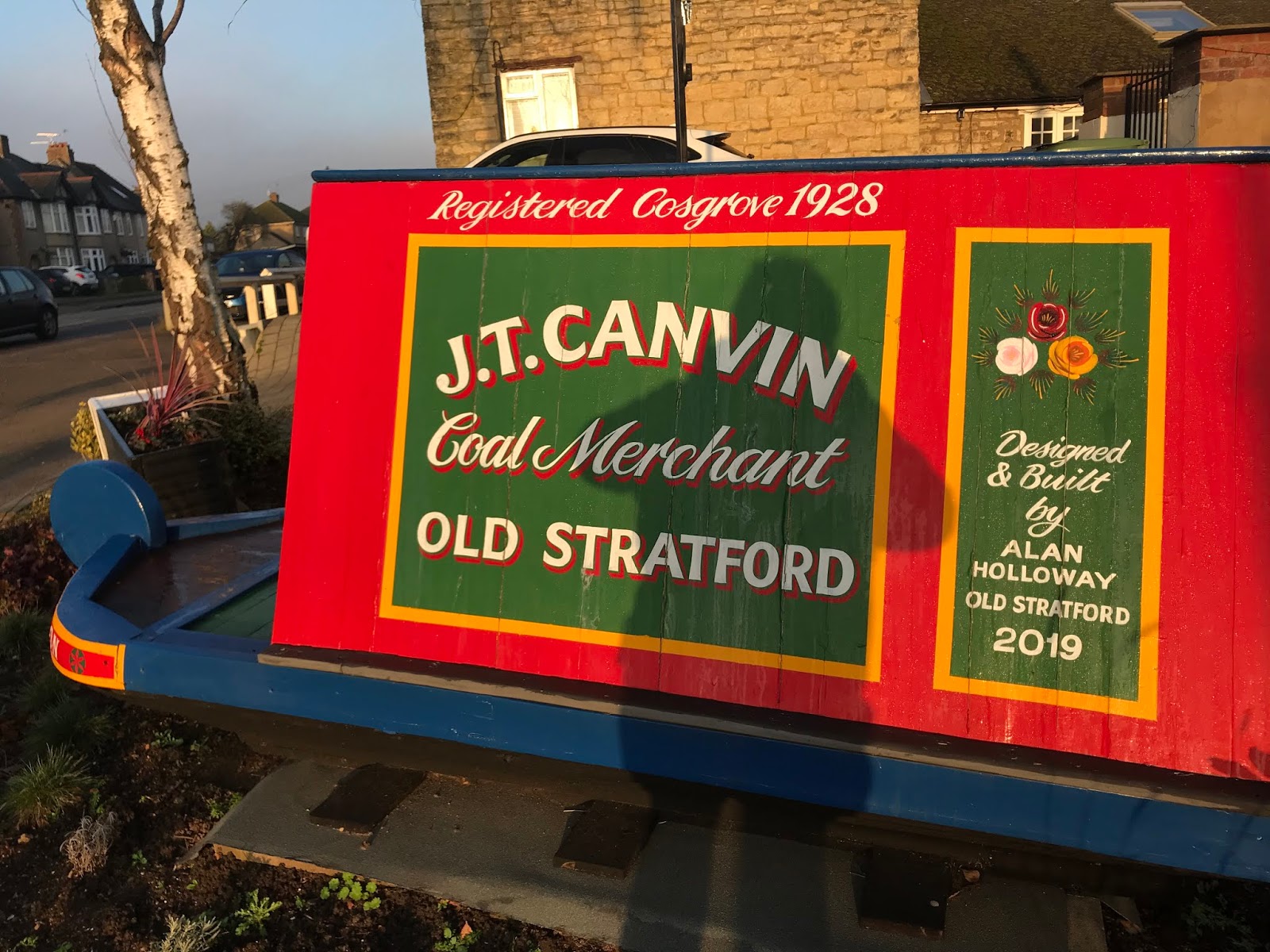
It therefore came as a pleasant surprise to see a model narrow boat being constructed just by the lights and close to one of the former local canal wharves. I have been promising to photograph it for some weeks but not had the opportunity - Watling Street is a busy road. However, between Christmas and New Year the roads were relatively quite and the sun was shining so I took the opportunity to take a few snaps.

The impression the wooden model gives is of a very short narrow boat because what might be the traditional back cabin is finished off by a prow which is adorned by the usual bow decoration and a boat name - Falcon which in the days of carrying was the name of a nearby inn.

An unusual road side memorial
Watling Street, Old Stratford (MK19 6AE)


The boat is decorated traditionally with the name of JT Canvin, Coal Merchants who operated at the adjacent wharf. The registration is given as Cosgrove 1928. Canvins were well-known locally. It appears that at the turn of the twentieth century they owned a steam narrowboat Jubilee which, if records are to be believed, was not very sound and appeared to sink in tunnels. It was eventually reported sunk in Old Stratford in 1961.

I think Alan Holloway, who appears to be responsible for this monument, should be congratulated for his enterprise and handicraft. What a good way to commemorate a location's canal history - particularly one that hasn't got a functioning link to our current system.


Batteries replaced and recycled

It's the time of the year when temperatures begin to drop and batteries struggle. As I reported on our recent Autumn Cruise, our stater battery failed as we started our journey. Well during our trip it was clear that our domestic batteries (I don't know why they refer to them as leisure) also struggled and it was clear that the little tell-tales that show their charging condition (acid specific gravity) was not showing green. So it was a big sort out. The failed domestic batteries had lasted over five years and the starter a bit longer - probably six.

I purchased two domestic batteries from Baxters at Yardley Gobio Wharf, swapped the temporary start battery they had supplied earlier into a domestic so I had three identical domestic batteries. I then purchased a new 664 starter battery from Midland Chandlers. Like many boaters I contemplated upgrading the domestic battery technology but given the cost, options available and the charging system on Albert, I went for a like-for-like replacement.

No green indicator despite the battery charger
(top centre of image)

Our truck-sized starter battery.

This left me with four dead 110 AH lead acid batteries. In the past I have taken the old batteries to the local tip, but this time I browsed the internet, talked to fellow moorers at the marina and decided a trip to a local scrap metal merchant in Bletchley was on the cards. The world of scrap metal is now very professional. I delivered the batteries to the yard; they weighed them and then directly transferred to my bank account around £40. It's well worth considering the local scrap dealer when disposing of  old lead acid batteries, it goes someway towards defraying the cost of the new batteries.