The Essence of Boating ?

Maggie and I attended a funeral service today for our friend Chris Allin who, apart from being a gifted musician, also lived for many years with his partner Maggie aboard his narrowboat Mr Blue Skies outside The Navigation at Thrupp Wharf, near Cosgrove. Some may remember how he used to organise the music nights for the pub.     

We never knew that he also wrote poetry and were amazed to read the poem below in the order of service. It just sums up the feeling you get each evening when you are onboard - particularly in winter. 

I just had to get blogging again. 


BCN Bi-Centenary 1969

 You may wonder why, after months of absence from the canal "blog-sphere" I am writing about an event over 50 years ago. 

Well firstly I will try and explain my absence. After Edward Winter's untimely passing I felt I just couldn't get back to reporting on my mixture of canal and river journeys, old waterway's books and memorabilia. My heart just wasn't in it and to some extent I always though of Edward as being "My Reader" - I would write with him in mind. 

Also my world of science, I am an editor of an international engineering science journal, just got busier and busier with researchers busy writing manuscripts during the Covid restrictions. I therefore set aside Albert's Blog "until the spirit moved me".

Well a couple of weeks ago my next door neighbour who knows my passion for canals donated some books and pamphlets that had been his fathers - mostly about the Llangollen Canal. He was de-cluttering prior decoration. As part of the handy package I obtained came a wonderful pamphlet for the 1969 IWA National Rally that was held on the Birmingham Canal Navigations to mark their 200th anniversary. The 53-page pamphlet is fascinating and the copy pristine. It has great articles that would not be out of place in Narrow Boat. In particular, the article on BCN history by J.L. Langford is really good. 


But why did that particularly move me to post about this now. Well the next image is the big clue!


   Yes, HRH Prince Philip who was patron of so many organisations was also Patron to the 1969 Rally of Boats in Birmingham. His interests in boats and sailing was well-known but I hadn't realised that he had a connection with the canals. At this time "Mr Birmingham" - Frank Price was Chairman of British Waterways and I just wonder if he was the one who persuaded the Duke of Edinburgh to oblige. The IWA were always trying to be well connected and I am sure they were pleased with the patronage. I can just imagine Peter Scott or John Betjeman asking him. However, I can't find a record of Philip actually visiting the rally.  It was also a critical time for canals and the birth of leisure boating. Encouraging public interest in what were seen by some as dirty and dangerous waterways was vital for their survival. 

As always with these booklets from bygone ages the adverts are revealing.


Braunston Marina full of GRP Cruisers

Early Steel narrowboats - note the prices

We will be out boating soon and Albert has had an updated galley. I will have to get back to more regular posting and perhaps even finish reporting on last year's cruising.


Our Boating Companion Edward Winter 1950 - 2020


Edward Winter navigating a very reedy section of the Aylesbury Arm in 2009

Since buying our first narrowboat in the mid 1990s, almost every year we were joined on our travels by our dearest friends Anne and Edward Winter. A quick look through this blog will reveal many references and numerous photos of the four of us navigating the inland waterways across the UK and even on one occasion along the Irish Waterways. With Edward and Anne's wedding anniversary in August we often celebrated on board with a special "towpath feast" - often Edward's favourite chilli con carne. 

With the recent Covid-19 Lockdown we have kept in close touch regularly by sharing Zoom dinners, even attempting to do this from Albert when on our recent journey to Napton. Unfortunately the lack of bandwidth west of Braunston defeated us. Last year Edward had some heart surgery but he had recovered well enough to indulge again in his passion for flying  - although not solo. All through lockdown he appeared well. It therefore came as a complete shock to receive a call from Anne on Saturday 18th July to say that Edward had died suddenly that morning. She was in deep shock and so were we. 

Edward was a warm convivial man who was a brilliant boating companion. He was capable of turning his hand to most things on board - even down the weed hatch where his height helped. He even brightened up dark evenings on board with his bewildering array of magic tricks. We will miss him dreadfully. His passing was made even more poignant because our Golden Wedding garden celebrations, which Anne and Edward were going to attend, were on the following Tuesday.  

We explored so much of the "system" together that I am sure I will always associate Edward with certain locations  - the Upper Thames, Grand Union summit, Leicester Arm, River Nene, Middle Level; the list goes on. We had wonderful times together - some were exciting like the Tideway in choppy conditions where Edward helped navigate, but others were just plain fun.

I will not dwell on all our exploits but quote from an early blog  - not ours but NB Balmaha. It epitomises the fun we had together. You have to picture us mooring up at a crowded Rushden and Diamonds on the River Nene back in July 2006. It is a warm summer evening and NB Balmaha were already moored up.  Mo reported:

"Again, we heard them before we saw them as nb Albert pulled up behind us and squeezed onto the last mooring bollard. With two families and a couple of comics onboard they were enjoying themselves and their chuckling kept us amused. "

Happy times!

There are many on-line tributes to Edward from his scientific colleagues and, in particular, the squash community. I shared his interest in science and his love of interesting cars, but boating with Albert will not be the same without the prospect of Edward coming on board, grabbing a windless and then asking if he can set the locks. I will even miss his long water-consuming on-board showers!


Priors Hardwick

A packed lock pound at Napton

It was busy on the Napton flight.

We got up fairly early, for us, and left our Flecknoe mooring around 8:30. We weren’t the first to depart because around 7.00 whilst we were dozing we heard a boat go past heading towards Braunston and at least two more passed us before 8:00.

We had decided to get an early start because it was clear that this post-lockdown weekend was busy and the Napton flight, which can get busy at the best of times, had the potential to be very busy. After following a couple of boats heading west (one who turned north towards Warwick and one stopped at Napton Narrowboats) and got to the bottom lock at Napton around 9:30 and found it quiet. A solitary hire boat was on the water point below the Folly Inn. A couple of CRT volunteers were operating the locks and this looked like the start of a smooth journal up the nine locks to Marston Doles. How wrong I was. The CRT volunteers were quickly moving boats up the flight to the first pound where there was serious congestion. Three boats were “permanently” moored up there and they had been joined by five boats waiting to enter the second lock. The first pound was in fact full of boats and the extra assistance from the volunteers had simply served to make things worse.

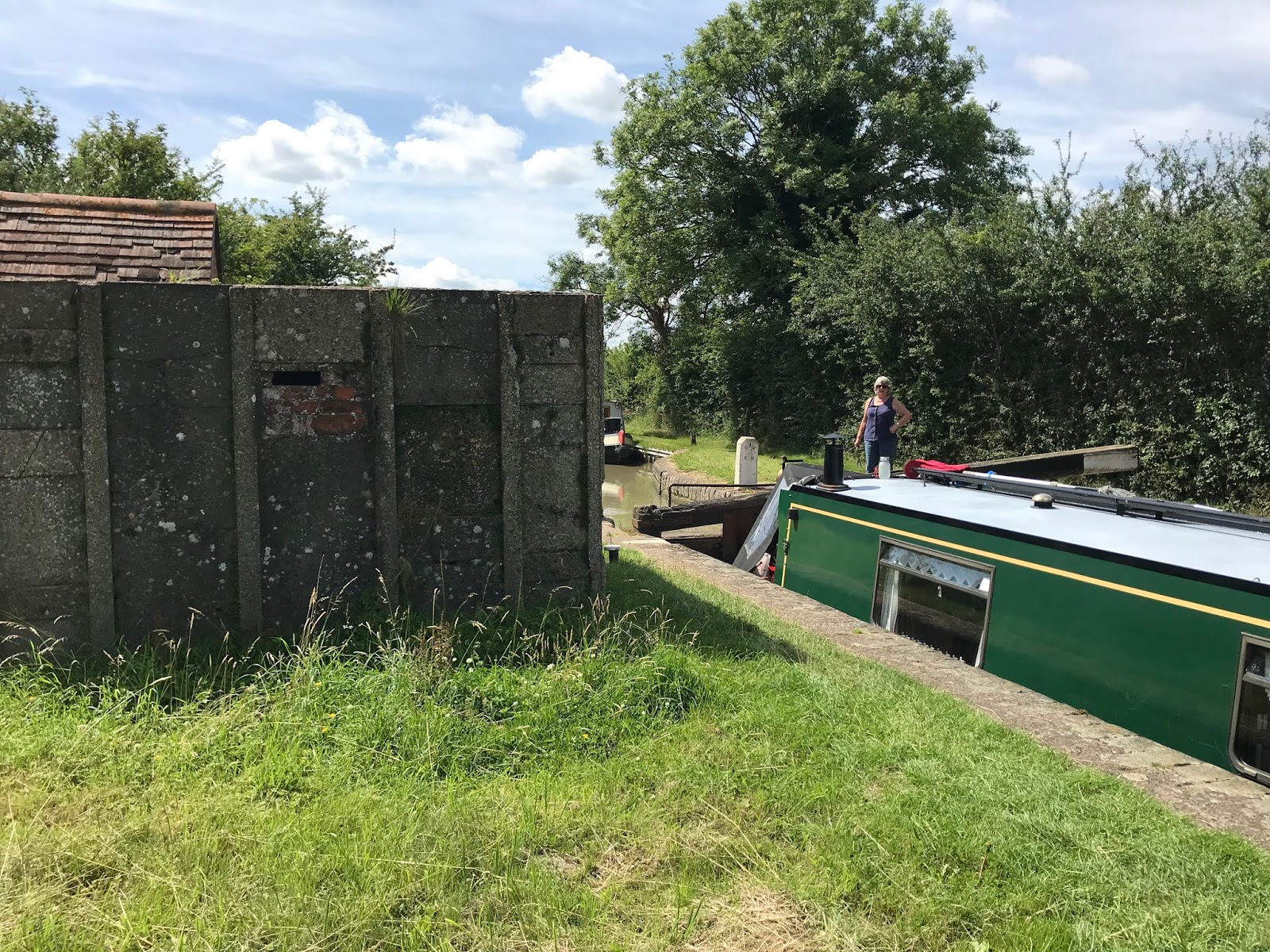
WWII Pill box on the Napton flight

Looking towards Napton Hill

Eventually the message got through and the volunteers began to hold boats back. To put it simply, there was no point in going up through the lock unless another boat came down. The result of all this congestion was the first lock of the flight took us over an hour to negotiate. Boats came down in a steady stream but those going up did not. Still, the weather was glorious, and a deer was spotted alongside the third lock. The water buffalo were in their usual field about halfway up the flight but not near enough to the locks to make a good photo.


Marston Doles top lock

Eventually the message got through and the volunteers began to hold boats back. To put it simply, there was no point in going up through the lock unless another boat came down. The result of all this congestion was the first lock of the flight took us over an hour to negotiate. Boats came down in a steady stream but those going up did not. Still, the weather was glorious, and a deer was spotted alongside the third lock. The water buffalo were in their usual field about halfway up the flight but not near enough to the locks to make a good photo.

Boat in a field (no water) on the Oxford Summit

We didn’t travel much further and stopped at one of our favourite mooring spots on the Oxford Canal summit near Priors Hardwick. It’s marked by a WWII concrete pill box on the off-side. 

Mooring at Priors Hardwick

As I write this, sheep on the former ridge and furrow cultivation opposite Albert are furiously grazing as the sun goes down. A typical rural English scene.


Braunston and Flecknoe


The weather was good and it was Saturday. With the lifting of the Covid restrictions we had thought that the canals around Braunston would be busy. As the phase goes, the world and his wife decided (like us) to remove the cobwebs and give the boat an airing. The first lock at Long Buckby was relatively quiet and when Ragweed and Albert left the lock there was no sign of any other boats moving. However, just as we left to pick up water the first of six boats arrived. Braunston tunnel was busy and slow but most boats were going the towards Buckby. We dropped down the flight with Ragweed passing an assortment of boats going the other direction. Frustratingly, there were a number of single boats from the same hire company who could have paired up and didn’t appear to have been instructed well. One crew appeared somewhat frustrated about their inability to understand what was required to operate a lock. With lock-down being raised, and overseas quarantines remaining, boating appears to be an attractive a British-based holiday. The section between Braunston and Wigrams Turn is usually quite popular for mooring and today was no exception. All the usual attractive moorings were busy and once moored up by bridge 102 a steady stream of boats passed all afternoon. The village of Flecknoe that looks down on this pretty stretch of canal and countryside looked an attractive proposition for a walk. We climbed the hill via the road, explored the village and then returned to the canal via a bridleway that cuts across the fields. The views from Bush Hill were stunning with beautiful fluffy clouds and blue sky. The fields were full cereals but not the usual wheat but barley and more interestingly oats. There were also some interesting patches of sunflowers mixed with barley and wild flowers.

Albert hiding from view

Wide vistas of South Warwickshire

Oats

Wonderful old sign on Bridge 103 Oxford Canal


Long Buckby

In the wake of the Covid-19 lockdown we finally managed get away on Albert because staying overnight on boats is now allowed. We are going to take a cruise along the South Oxford which will be interrupted by a short period at home to celebrate our landmark wedding anniversary. The weather was dry as we left Yardley Wharf on Thursday but it became damp and then wet as the day wore on. We went up the Stoke Bruerne flight with a hire boat from Gayton and were assisted part of the way by a pair of CRT volunteer lock keepers.

Our first post-lockdown locks

At the top lock I was taken aback a little when I found a swan family coming out of the lock as the gates were opened. It appears that boaters were being encouraged to try and keep the family in the top pound to avoid potentially lethal confrontation with another more aggressive family further down the flight. The operation of retaining them in the lock was quite an exercise – carrot and stick but with duck food.

Locking Swans

We had a good trip through the tunnel where it was a relief to get out of the rain. We eventually moored up just north of Gayton Junction at one of our favourite spots.

On Friday the weather was much better. We popped in at High House Wharf to discuss a possible paint refresh on the grey colour of our roof with Colin Dundas. The traffic on Thursday had been light but around Weedon more boats were on the move. We reached Whilton just after lunch, picked up some supplies including some gas and then went up the flight with Ragweed a hire boat from Weedon. The couple hiring the boat were from Kent and admitted to being relative novices. However, they handled the boat well and together we made good progress up the flight aided for most of the locks by a steady stream of boats coming down. We moored up just below the top lock and Ragweed joined us. Opposite was a delightful garden and we got talking to the owners who are showing it as part of the National Garden Scheme. It appears that the scheme will operate by appointment under the current Covid-19 regulations. We had a long chat because it turns out we have mutual friends.


Geoff is a retired railway signal man and Sue is a talented canal can painter keeping the Buckby can tradition going. One of the cans on Albert is Sue’s work – we purchased it at Crick Boat show a few years ago. The garden also boasts the top part of a signal from Harpenden which works, a low-level shunting frame signal and a streetlight from Droitwich circa 1930 complete with operating original bulb.

A Roses but not Castles Tray

Long time readers of our blog may recall that I posted about the origin of Roses and Castles decoration way back in 2008 when I came across a blue underglaze plate with a scene reminiscent of the traditional Roses and Castles. Having read Tony Lewery's two books on canal boat painting (Narrow Boat Painting and Flowers Afloat) I have been aware for some time of his hypothesis that the inspiration for the style came from not only Victorian pottery decoration and but also Jappaned goods. I was therefore delighted when the other day we got a present of a decorated metal tray that our daughter Lucy had picked up at antique fair in West London. She described it on the phone as being "a bit like Roses and Castles". When we got it we found it had all the hallmarks of the traditional Roses and Castles style - but minus the castles. It is probably what is described as Toleware.

Our painted metal tray

The tray is just over a foot in diameter and has a dark green ground that is similar to many of the shades used on narrowboats. The flower decorations are very similar to that found on traditional canal boat decoration and the roses in the centre are painted are clearly painted in the same manner with confident sweeping brush strokes. The perforated edge to the tray shows signs of gold paint. We have no idea as to its age (or even its country of origin) but we think its a very pretty item. If could be old, that is Victorian, and this would certainly reinforce the theory put forward by Tony Lewery since the painting technique is so similar.

.


First Trip of the Covid-19 Crisis


So with CRT advising:

"From today, Weds 13 May 2020
You may undertake short boating trips only from today – avoiding use of locks and any staff-operated structures if possible – providing, as per current government guidance, you do not stay away from home overnight and return to your home mooring (where you have one)."


we managed a short trip out for the first time since I don't know when.

 In fact with other pressures on our time pre-crisis this is the first cruise of the year. Albert need a bit of fettling after the winter before we got out of the marina by midday.

We managed it all the way to Cosgrove Lock and back but took the opportunity to drop in at Baxters at Yardley Wharf to use their services (pump-out and diesel). The weather was just glorious and ideal, it made us wish for a long trip.

Grassy Towpath near Yardley Gobion

Met some neighbours from our village walking a circular route and had a socially distanced conversation. There were a couple of other boats moving but understandably it was quite. We must do more of this!


Old Stratford Wharf

We pass along Watling Street almost daily since we live just north of Stony Stratford. I am familiar with the route of the Buckingham Arm of the Grand Junction and the Old Stratford Branch in particular. I often sit at the traffic lights at Old Stratford in queues of traffic thinking of the boats that used to pass under Bridge 2 (the so-called Old Stratford Tunnel) on their way to and from Deanshanger and on to Buckingham. I blogged about the tunnel back in 2015.

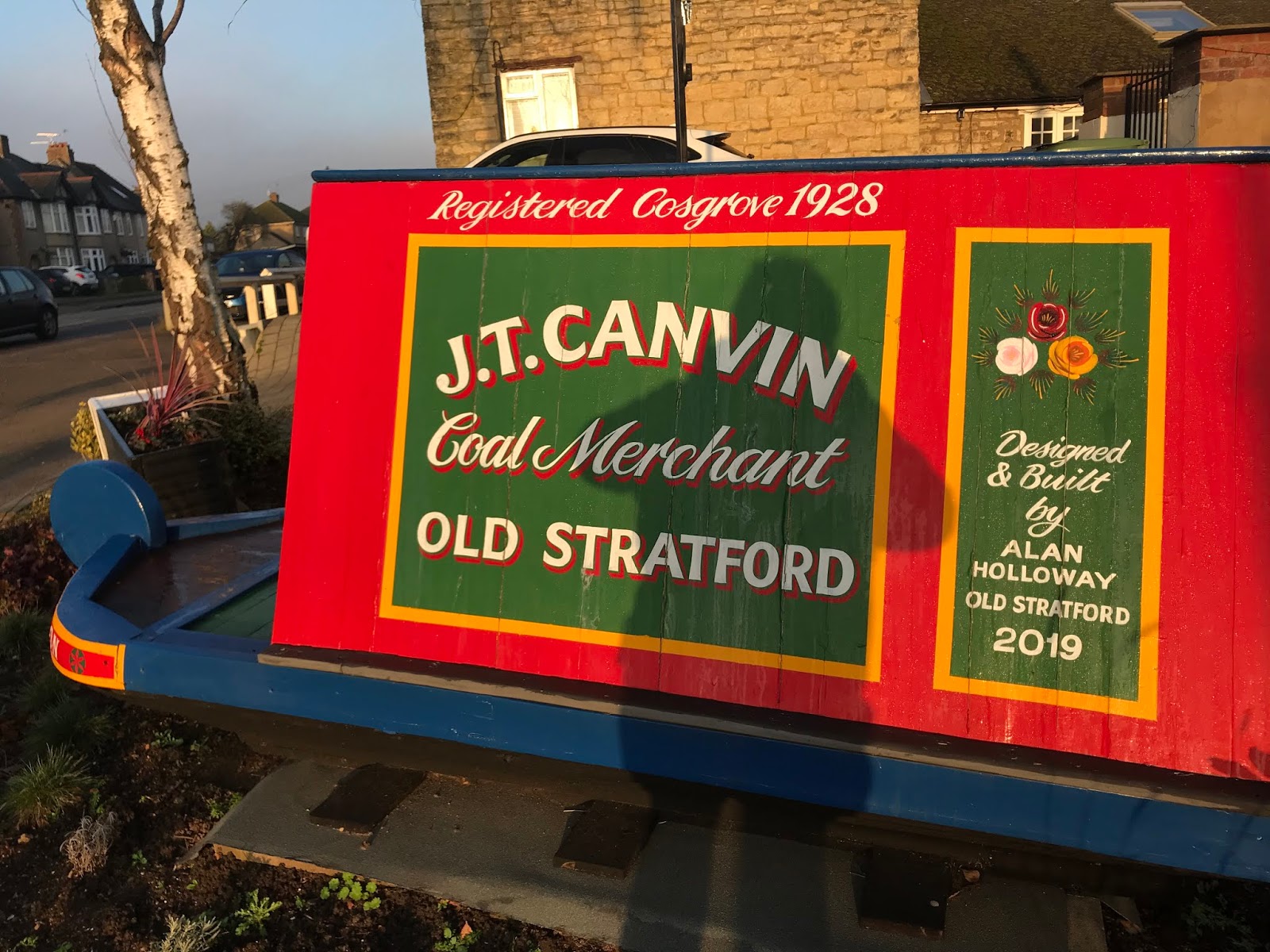
It therefore came as a pleasant surprise to see a model narrow boat being constructed just by the lights and close to one of the former local canal wharves. I have been promising to photograph it for some weeks but not had the opportunity - Watling Street is a busy road. However, between Christmas and New Year the roads were relatively quite and the sun was shining so I took the opportunity to take a few snaps.

The impression the wooden model gives is of a very short narrow boat because what might be the traditional back cabin is finished off by a prow which is adorned by the usual bow decoration and a boat name - Falcon which in the days of carrying was the name of a nearby inn.

An unusual road side memorial
Watling Street, Old Stratford (MK19 6AE)


The boat is decorated traditionally with the name of JT Canvin, Coal Merchants who operated at the adjacent wharf. The registration is given as Cosgrove 1928. Canvins were well-known locally. It appears that at the turn of the twentieth century they owned a steam narrowboat Jubilee which, if records are to be believed, was not very sound and appeared to sink in tunnels. It was eventually reported sunk in Old Stratford in 1961.

I think Alan Holloway, who appears to be responsible for this monument, should be congratulated for his enterprise and handicraft. What a good way to commemorate a location's canal history - particularly one that hasn't got a functioning link to our current system.


Batteries replaced and recycled

It's the time of the year when temperatures begin to drop and batteries struggle. As I reported on our recent Autumn Cruise, our stater battery failed as we started our journey. Well during our trip it was clear that our domestic batteries (I don't know why they refer to them as leisure) also struggled and it was clear that the little tell-tales that show their charging condition (acid specific gravity) was not showing green. So it was a big sort out. The failed domestic batteries had lasted over five years and the starter a bit longer - probably six.

I purchased two domestic batteries from Baxters at Yardley Gobio Wharf, swapped the temporary start battery they had supplied earlier into a domestic so I had three identical domestic batteries. I then purchased a new 664 starter battery from Midland Chandlers. Like many boaters I contemplated upgrading the domestic battery technology but given the cost, options available and the charging system on Albert, I went for a like-for-like replacement.

No green indicator despite the battery charger
(top centre of image)

Our truck-sized starter battery.

This left me with four dead 110 AH lead acid batteries. In the past I have taken the old batteries to the local tip, but this time I browsed the internet, talked to fellow moorers at the marina and decided a trip to a local scrap metal merchant in Bletchley was on the cards. The world of scrap metal is now very professional. I delivered the batteries to the yard; they weighed them and then directly transferred to my bank account around £40. It's well worth considering the local scrap dealer when disposing of  old lead acid batteries, it goes someway towards defraying the cost of the new batteries.

Stoke Bruerne (and Home)

Yesterday we left Gayton in sunshine and made our way to Blisworth. The trip through the tunnel was clear with nobody coming in the opposite direction. We had a pretty rapid transit.

Stoke Bruerne was very quiet. The Canal Museum is closed on Mondays but I think the real reason is that the half-term holidays are over. No other boats were moving.

A quiet Monday at Stoke Bruerne

The first two locks we set for us (full) and then we passed another boat coming up who announced that the next three were set for us. In fact all the way down the flight all the locks were either full of half-full. This meant we cleared the last lock in good time.

We paused to take on water at the bottom lock and were appalled at the conditions of the towpath. I know its been raining a lot recently but the area is impassible for walkers - the puddles are enormous and deep. We've contacted CRT to complain. It needs grading and the drainage sorting.


What a mess!

We missed seeing NB Sculptor on its usual mooring by the museum, but they passed us going north just above Grafton Regis - just where offside vegetation makes the canal very narrow. A winter job for somebody?

Then started the process on packing up and closing up. Our trip has also highlighted that not only did our starter battery also needed replacing - it could hold a good charge overnight. Since the batteries were around 5 years old I suppose that is par for the course. Some searching online for bargains is called for.

Gayton

No not the junction - we are moored up opposite the village of Gayton which is some distance away from the start of the Northampton Arm. As we arrived this afternoon the church bells were ringing and the sun was shining. It wasn't like that earlier today. As we left Long Buckby this morning it was quite different - cloudy and drizzly.

Our evening view
The moon and its reflection, Virgin Train going south, and the Village of Gayton on the hill

We left our mooring below Buckby Top Lock this morning and made very good progress down the rest of the flight. The first few locks were set in our favour and as we progressed we met boats coming up. As a result we managed to clear the flight by 11:15.

South of Whilton the canal is heavily wooded and the section through Brockhall was a bit like travelling through soup. It took a few judicious applications of reverse to keep the prop clear. After Weedon the weather improved and the rest of the day was dry and bright.

Clearing weather at Swingbridge Wharf


Autumn on the canal

We got to Gayton we met a few friendly passing dog walkers who were enjoying the weather. One who was also fishing related how he had seen otters along this stretch. We weren't as lucky, although we watched a heron fishing. However, earlier on we did see three kingfishers and one even dived during its flight. 

Tomorrow we are should be back in Yardley Gobion so we will set off for Blisworth and Stoke Bruerne in the morning.

Watford and Norton

Today we watched the Rugby Cup Final moored up near Weltonfield Marina. Shame about the result. Too much to hope that England would beat all the Southern Hemisphere rugby giants at one tournement.

Once the match was over we set off towards Watford. Our original intention was to try for Welford but that was plainly too much since we need to be home on Tuesday. We therefore winded below Watford Flight. The wind was very strong and it rained off and on. This brought down clouds of leaves which blew like a blizzard across the cut. Albert is a relatively heavy boat but we soon began crabbing. However, the winding hole at Watford of sheltered and "roomy" so turning was fine.

Watford Gap Services from the Canal

We retraced out steps to Norton Junction where we took on water. Mooring was plentiful at the junction but we decided to drop down one lock to use one of the more cozy moorings. Our intention is to go down the rest of flight tomorrow. So we decided to take a stroll around the fields along the Leicester Branch.

Obviously another enthusiastic Ruston owner 
(at Norton Junction)


Wallking along the moorings at Norton we discovered NB Trevor, a steam-powered narrow boat built around 1995. It is diesel fuelled which must make it more convienient to operate than classic steamers fuelled by coal. It appears that it has just changed hands from being moored on the Basingstoke Canal.

Steam Narrowboat Trevor


Diesel furnace and steam engine

Because of the canal's elevation the views around Norton are impressive. Today the lines of black clouds, and the sun occasionally breaking through, made this Midlands landscape look and feel very autumnal. Tonight we shall walk up to the New Inn where it should be warm and cosy.

Wool on barbed wire near Norton


An enormous Badger Set


An Autumn Cruise

An opportunity to go cruising arrived so we are heading north for a long weekend. On Thursday the weather was fine and sunny as we got ready to leave but we had seen the forecast which didn’t look good. The only problem with our start was Albert’s starter battery failed! We managed to quickly get a substitute from Baxter’s and we soon fired up the engine and were on our way.


Halloween Pumpkin

At home we had prepared a pumpkin (with two cat faces) and so were Halloween-ready! At Stoke Locks we met hire boat returning to Weedon so we paired up for the first lock. We then found another boat above the lock waiting to go up. After some adjustments we waited and went up the flight with a UCC hire boat from Braunston with a group of scouts from Essex. They were very helpful and made a good locking team. They stopped in Stoke and we carried on through Blisworth Tunnel finally stopped for the night at Bugbrooke, opposite The Wharf Inn, even though it was only 4:30 – it gets dark early these days. We just had to go into the pub for meal and drink.

Bloggers Derwent 6 moored at Heyford

Friday, the first day of November, was wet and windy. Overnight a plethora of leaves had landed on Albert’s roof. Passing through Heyford we found bloggers Derwent 6 moored up. At Furnace Wharf we disturbed a kingfisher who scurried along in front of us.

At Buckby bottom lock we dropped in to Whilton Marina café and had some delicious soup for lunch. A steady stream of customers came in while were there. Obviously a popular local venue.
Going up the Long Buckby Flight we met a few boats coming down which helped, but the lock mechanisms are so stiff the flight is never a pleasure.


We turned off up the Leicester Branch and moored up for the night near Weltonfield.

Yukon River - a waterway with a unique history

The Yukon River is the fifth longest river in North America at some 2,000 miles long. It rises on the border between British Colombia and the Yukon Territory and flows north-west towards Alaska and into the Bering Sea. What I hadn't realised, until our recent trip to Alaska, was its role as a major navigable waterway and its economic importance, if but for a short period of time.

In July 1897 a small steamship called the Excelsior brought a small group of men back to San Francisco with gold they had just discovered in the Klondike. This was shortly followed by another ship bringing more miners and a ton of gold. The newspapers went crazy and men from all over the world flocked to Dawson City seeking their fortunes. Of course, very few did.


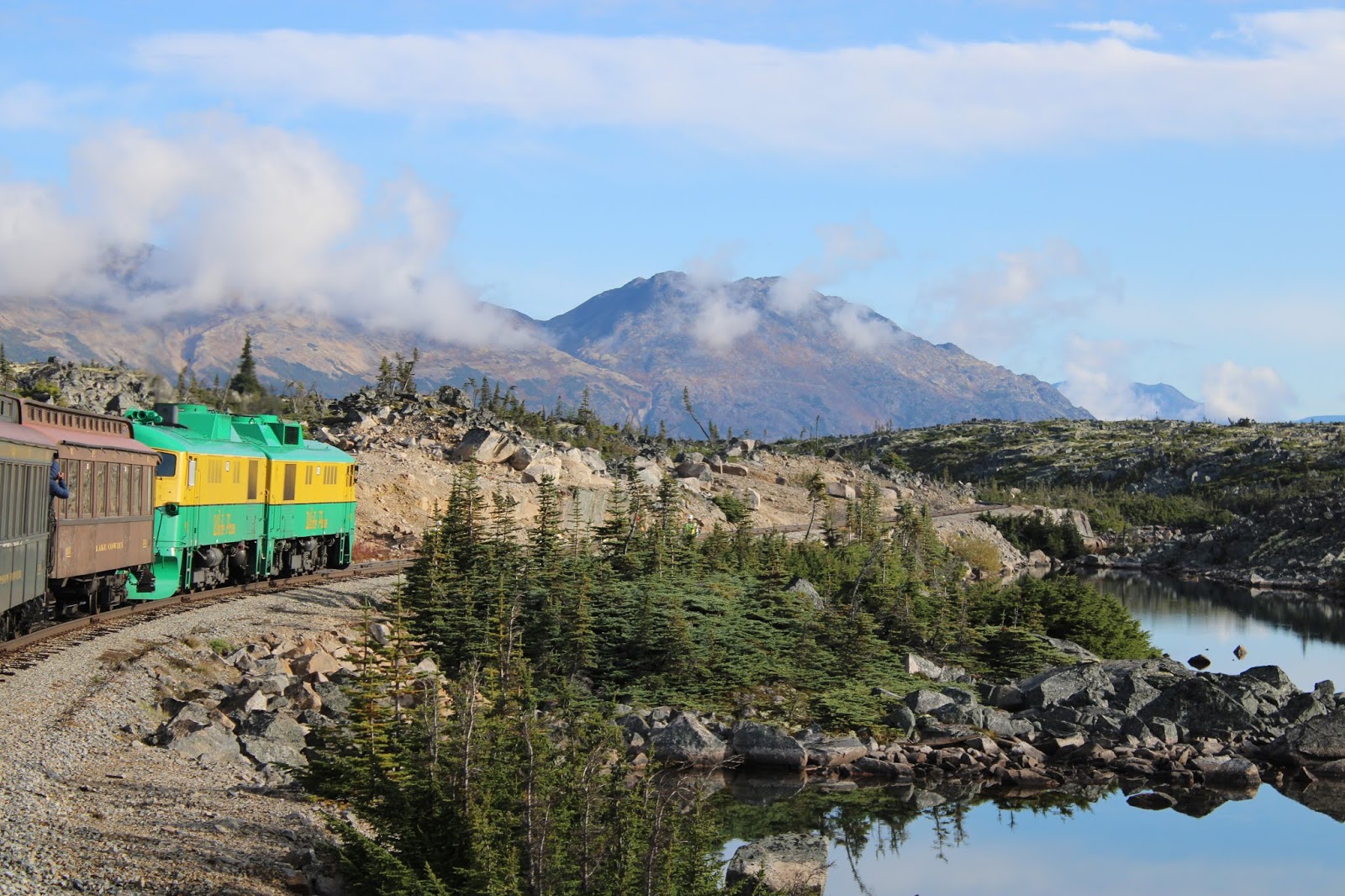
The route to the gold fields for those seeking their fortune was not simple. There was the difficult sea route to the mouth of the Yukon River at St Michael in the Bering Sea and then an upstream journey by paddlesteamer, but it was expensive, long and difficult. Those with less resources travelled a more direct route by sea to Skagway, a small port on the Inside Passage. They then trekked over the coastal mountains to the headwaters of the Yukon. It was then downstream by steamer to Dawson. The route was arduous and many died in the mountains despite the Canadian authorities demanding that stampeders (as they were called) only entered the Yukon Territory if they had a ton of suppliers. But born out of such difficulties came a business opportunity - a narrow-gauge (3 ft) rail route was built over the mountains joining up to the river. This is the White Pass and Route which still exists today and which we travelled on last month. It is a fascinating railway and truly spectacular. The connection to an historic river transport system also fascinates me.

White Pass and Yukon Railway

Route the original stampeders took

An original trestle bridge 
(now retired from use!) 

At the summit

On our visit to the Yukon we left our cruise ship at Skagway, Alaska and joined a train pulled by two historic diesel locomitives up a series of tight passes, over trestle bridges and through tunnels to the summit at Fraser where crossed into the Yukon Territory, Canada. It was an unforgetable ride. We moved from the train onto a coach and travelled through the upper reaches of the Yukon stopping at various tourist spots that included spectacular views, but the place I will not forget is Carcross which was originally known as Caribou Crossing. It is now a small community with only a population of 301 but back in 1889 it was an important staging post during the goldrush. It is here that there are the remains of SS Tutshi, one of the mighty stern paddlewheelers that used the travel along the river between Whithorse, Dawson City and St Michael.

The tiny community of Carcross now relies on summer tourism but it doesn't take much to visualise the "town" during the Goldsush and its immediate aftermath. The size of Tutshi is impressive and its characteristic design must have appeared awe inspiring at the turn of twentieth century. I certainly impresses me today. Tutshi was 167 ft long and displaced 1041 tons. The sight of one of these wood burning steamers navigating through Five Finger Rapids using winches, and the annual spring races to be the first steamer to Dawson City following the ice-melt must have been something to behold. Unfortunately as Tutshi was being restored when she was heavily damaged by arson in 1990. Some idea of the steamer in her prime can be seen here in 1987. It was common to see the Yukon sternwheelers on the river bank because they were often hauled out for the winter.

Remains of SS Tutshi


Replica of Tutshi's Sternwheel

Tutshi's Boiler

Interpretation Board Image of Tutshi on the River Bank

Bennet Lake Beach, Carcross

Railway Bridge, Carcross

Bennet Lake

Image result for steamer five finger rapids
Sternwheeler negotiating the Five Finger Rapids using Winches

If you want to find out more about the river boats I can recommend the excellent well-illustrated book by Graham Wilson "Paddlewheelers of Alaska and the Yukon". There are some also some helpful websites for visitors such a Destination Carcross Yukon. If you are near Skagway a trip along the White Pass and Yukon Route into the interior  just has to be a must.