Thames Path

We visited our daughter Lucy who lives in Teddington with husband Chris. Because the weather was fine we walked from Teddington Lock to Ham House via the Thames Path. It was good to see the new moorings at Teddington Lock. We hope to make use of them during the summer.

The river was flowing full and there were Yellow Boards up; it was just like last summer!

Just off the path we discovered the obelisk that marked the boundary between the Thames Conservancy and the Port of London Authority. It looked somewhat overgrown. It was not as Steve remembered in the 1960s when he rowed along this stretch taking eights down to the Head of the River. Presumably the trees have grown a lot in the last 40 years!


Port of London Authority - Thames Conservancy boundary marker

The gardens at Ham House were delightful. Can recommend the cafe for lunch.

Vagabonding through the Midlands by Quaestor

Although we are itching to go boating over Easter the weather forecast looks so dreadful I fear we will have to stay at home. As a consolation I decided that I must update the blog with some of my winter reading.

I continue to extend my waterways second-hand book collection – mostly with pre-war travelogues and books dealing with canal history. My most recent purchase was another couple of books from ebay, again for only around £5.

Vagabonding through the Midlands was published in 1935. It doesn’t only cover boating it also covers travelling by roads, when road travel was more of an adventure, and it includes some railway journeys; there is a brilliant description of a footplate journey from Wolverhampton to London on an overnight goods express. It is almost the prose equivalent of W H Auden’s Night Mail.

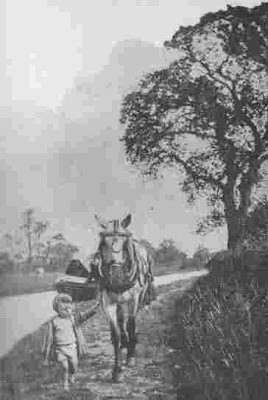
So what of the waterways connection? Well one section, three chapters, covers a remarkable journey from the author’s base near Wolverhampton to Llangollen using a horse-drawn narrowboat hired from Midland & Coast Canal Carriers of Wolverhampton. The hold of Neptune was adapted for the author and his family. This included a false bottom and areas under cloths set out as dining-rooms, sitting-rooms and cabins. There is reference to the use of deck-chairs, a small library and even a portable gramophone. The boat was crewed by the Wildey family and hauled by an ex-hunter called Daisy.


The author's son Charles, aged 3, leading Daisy pulling Neptune

There are evocative descriptions of how the boat was operated and some excellent descriptions of working boats. The author’s discussions with Neptune’s skipper, Sam Wildey, obviously made quite an impression on the author. It gave him an insight into the lives of boat people. Quaestor was, of course impressed with their skills and he writes about how beautifully kept some cabins were. But he obviously understood that the lives of boatpeople were hard. He was certainly not sentimental about there conditions.

“The canals are the only places where there is real child labour in England today and little seems to be known about it by the authorities.”

“Still another generation of illiterate boat people is therefore being created to our discredit, and no-one seems able to do anything about it.”


He even finishes the boating section pointing out how beautiful was the view from the canal at Llangollen but how true was the adage that other people’s jobs are rarely what they seem.


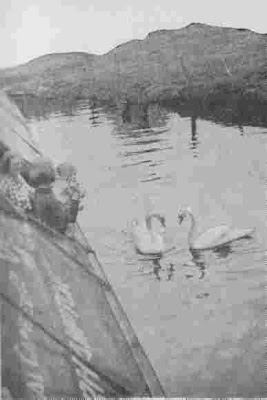
Morning on the Canal

You may recall the difficulties Tom Rolt later had getting Cressy to Llangollen. Well Neptune, although relatively lightly loaded, did run aground on their trip.

So who was Quaestor? He was Wilfred Byford-Jones (1907 – 1977), an author and journalist who wrote extensively for the Wolverhampton Express & Star and lived from some time at Beckbury. Aside from his travelogues and mystery stories, he appears to have written some important historical accounts of Greece during the second world-war, of the Cyprus conflict, and of the Arab-Israel war. To find out what about what a quaestor is, try Wikipedia.

Steve Parkin

Narrowboat Banstead

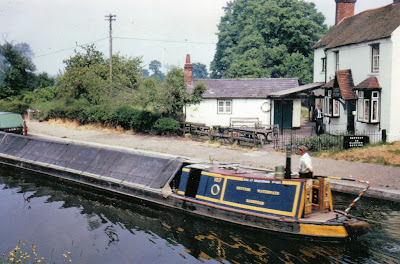
Last May, when I wrote about the conversion of NB Lion, I published the photograph below taken by Maggie's Uncle, Ken Tremain, in about 1966. It shows the motor Banstead passing the Black Boy Inn near Knowle on the Grand Union. Banstead is a Harland & Wolff Large Woolwich (Town Class).


NB Banstead passing the Black Boy

It is interesting to note that NB Banstead is now up for sale on two web sites, Apollo Duck and boatsandoutboards. Banstead appears to be much refurbished and, from reading the advertisment, it appears it has a screen history as the motor boat in Harry H Corbett's film "The Bargee". I must get a copy of the film.

The photographs on her own web-site show her in good condition. I hope any new owner keeps her the same.

Steve Parkin

Tunnel Lights

We moor Albert just south of Blisworth Tunnel and often go through both Blisworth and Braunston Tunnels. As result we consider ourselves to be relatively experienced tunnel travellers. It was therefore interesting to see Andrew Denny's (Granny Buttons) recent photos of Preston Brook Tunnel because I've yet to take a decent photo anywhere in a tunnel, let alone one of an air-shaft.

I then got thinking about a subject that occasionally vexes me, that's tunnel lights. However, before I discuss them, I must repeat the old boating joke about tunnels. Sorry if you've heard it before.

What's the boater's definition of a pessimist? - someone who thinks the light at the end of the tunnel is a boat coming the other way.

So what about tunnel lights? There are numerous different lights used on canal boats from humble automotive fog lights to gleaming brass fire-engine searchlights. So just what is the ideal light?

When we started boating I remember discovering some BW advice that a tunnel light should mainly illuminate the arch of the tunnel to aid steering and definitely NOT shine down the tunnel and blind boaters travelling in the other direction. At that time our boat carried a Hella fog light fitted with a diffuse glass front lens, so I was happy.

After 12 years that advice still appears to me to be sound. After all boats only travel slowly through tunnels - steerers do not need to see hundreds of yards down the tunnel to avoid a boat coming in the other direction - it just doesn't help. However, appearances can be deceptive since some large searchlights are modified and use diffusers so they don't create problems and some small lights can produce narrow bright beams. It is the bright pencil thin beams that shine well down the tunnel that cause problems. They don't help the steerer of the boat on which they are mounted because they can't see the tunnel profile properly, and they definitely don't help those coming the other way!

So what sort of light does Albert have? Well it's not a searchlight but it is fairly large and is, of course, brass. According to Albert's the previous owner, the tunnel light was acquired as a pair by the owner of NB Oak who was friend and moored in the next berth at Bradford-on-Avon. He purchased a pair of Lucas headlights at a classic car auction, kept one himself and gave the other to Mike Hurd for use on Albert.
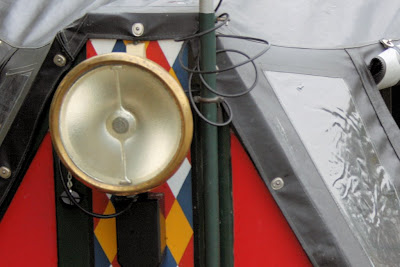

Albert's Tunnel Light

So what model are the lights and what vehicle were they mounted on?

From an old catalogue I found that the lamp(s) are Lucas R160S circa 1932. It is a “King of the Road” Bi-flex lamp. It was probably originally chromed and is missing its reflector retaining clips. Crucially, it has a new front glass – possibly similar to Lucas “Difusa” glass. As a result it produces a diffuse beam of light. The R160S model was superseded by the LBD165S which has the same dimensions. It was fitted to the following 1932 cars: Armstrong Siddeley 20 h.p., Humber 16/50, and Morris Oxford 6 cyl. “LA”.


Morris Oxford with Lucas Bi-flex Headlamps
(crossing a canal bridge?)


So does it matter where lights are mounted? Not in my view although it helps to avoid places where the crew can walk in front of the beam at crucial moments. The main thing is where they are pointed. Preferably not directly pointing at the roof of the tunnel or to the water (we've seen both of these). And certainly not moved around by the crew as we discovered last summer in Blisworth tunnel.

Happy tunnelling!

Steve Parkin

Brass Clocks

Almost all narrowboats appear to sport at least one brass clock (chronometer) and also a barometer. Albert is no exception. When we first became boat owners in 1996 we purchased a battery operated chronometer and an aneroid barometer and they are still doing us pround. We swapped them onto Albert when we sold our first boat. We weren't partcularly intending to get any more brass clocks for Albert, since we already had a decent replica brass clock in the galley, but just over a year ago an opportunity arose to get an unusual and authentic marine chronometer.

When I was working at the research institute at Wrest Park in Bedfordshire, an unusual maritime chronometer was mounted on the wall of the laboratory. It appears that one of the former researchers was a keen sailor and he presented it to a collegue as a leaving present. Unfortunately, with the passage of time, it failed to work and when that collegue also left it looked like it was destined to remain on the wall until scrapped. I could't bear to see it go to waste so I contacted the last owner, who confirmed he didn't want clock and was happy to see it go to a "good home". I then set about getting it restored and researching its history.

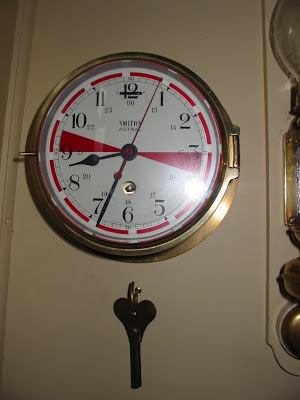
It got it repaired by a member of the British Horological Institute (i.e. people who deal with real clocks) and mounted in the engine room of Albert. The dial indicated that it was a Smiths Astral. A web search indicated it was manufactured in the 1960s and is a Smiths model 6156 WRD. It is a workman-like choronometer with a fairly ordinary metal case. Evidently the Astral was once widely found on merchant vessels throughout the world with various different dial designs available depending on where on the vessel the clock was to be used. For example, in the captain's cabin or the saloon they generally used roman numerals and didn't have a second hand.


Smiths Astral WRD clock

So why the red segments on the dial just after quarter past and quarter to the hour? The clock has a WRD dial, which is the abbrevaition for "wireless room dial". The red segments indicate the period in each hour where radio silence should be observed so radio operators could listen out for emergency signals. Evidently, radio silence periods were introduced for radio telegraphs after the sinking of the Titanic and it appears that they continued until 1999.

There's not much call for radio silence on the Grand Union, or radio telephones come to that, but it makes useful addition to the engine room since it's an eight-day clock and does keep good time. The only negative is that it has a quite a loud tick and has occasionally kept us awake when we sleep in the nearby boatman's cabin.

Steve Parkin