Solar Eclipse on the Llangollen Canal, August 1999

Sky-gazing conditions in Northamptonshire are not suitable for observing today's partial eclipse of the sun, but we clearly remember the last eclipse.

On 11 August 1999 we were on our first cruise along the Llangollen Canal in our first boat Bertie. Around the Wrenbury area we were travelling towards the Hurleston when we experienced full totality. Conditions were not perfect but at least the cloud was broken and not a blanket.We observed the process in the reflection on the water of the canal, and also via a bucket of water carried on-board.  I got the picture below with my Minolta 35 mm film camera but you need an eye of faith to recognise it as an eclipse.

Eclipse above the Llangollen Canal, August 11, 1999

Perhaps the most dramatic part of the process was the very perceptible drop in temperature that occured; for a warm August for a while it got quite chilly. The eclipse also had on effect on bird-life. For quite a while this rural location became very quiet and still.

Bertie descending Grindley Brook Locks, August 1999

Sinking of Cressy - A Mystery

Following the publication of Narrow Boat in 1946, Tom Rolt’s converted Shropshire Fly Boat, Cressy, became the most famous of all canal boats but unfortunately she was not to last long. Following the well-known differences between Aickman and Rolt that split the Inland Waterways Association (IWA) and the acrimonious Market Harborough Rally in 1950, Tom Rolt took Cressy to Banbury for the winter. Not only had his relationship with the IWA and his marriage to Angela deteriorated but he was to find that the condition of Cressy had also become critical. This sad period in his life is reported in detail in his autobiography Landscape with Canals

Cressy was moved to Stone in the spring of 1951 to be in the care of Rendel Wyatt. After an attempt at selling her failed because a survey had shown her wooden hull to be rotten, she was towed to a backwater of the Trent & Mersey, left to sink and rot; eventually she was broken up and burned. Rolt never enquired about her whereabouts and did not want to see her again. Cressy had not only been part of Tom and Angela Rolt’s life since 1939 but she had been part of Tom’s family as early as 1929 when his uncle Kyrle Willans had bought her. She was converted by Willans from a horse boat to steam power and it was with Cressy in this form that Tom Rolt and his uncle took a two-week cruise.

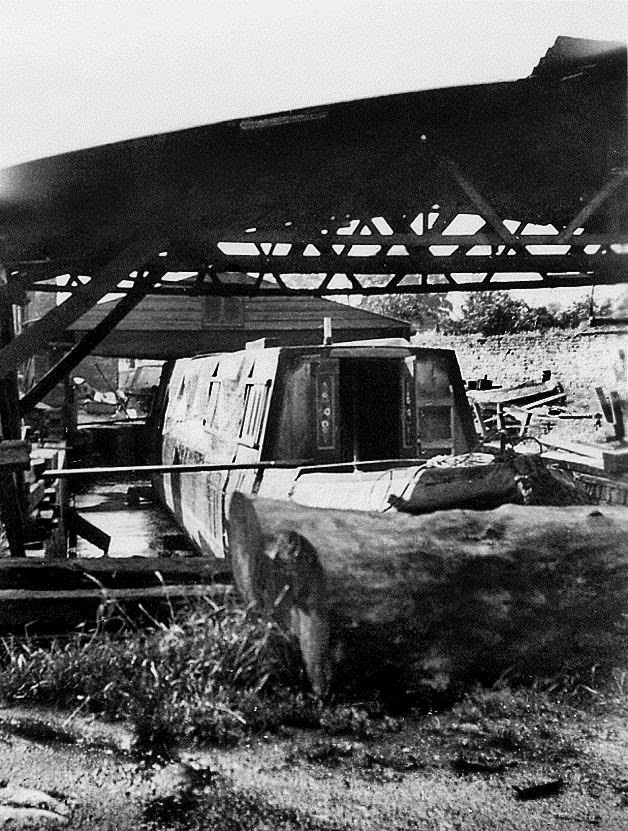
There are only a few readily available images of Cressy. Some are shown in later editions of Narrow Boat and some are in Ian Mackersey’s book Tom Rolt the Cressy Years. So it was with great interest that I found what is claimed to be a photograph of Cressy on the front cover of one the editions of Windlass in my bound volume. Not only does the photograph purport to be of Cressy but it’s title is rather tragically, “Sinking of the Cressy”. The edition (Volume 22) of Windlass was evidently published in February 1961, although the printer dated it as January.

Cover of Windlass, January 1961

The boat shown in the photograph (above) appears to be lying in a rather perilous state and it looks like it could be Cressy. The editor, Michael Baldey, notes in his column that the picture is a sad one and that it “depicts the tragedy of Cressy, player in the title role of Mr Rolt’s classic “Narrow Boat”. He notes in his column that he has no details of the photograph but that it “came unexpectedly into our hands”. There is some obvious doubt in his mind about authenticity since he comments “if anybody could lighten us further...”

The following issue of Windlass has two letters referring to the cover photograph. One relates a story of the demise of Cressy which is similar to that reported in Landscape with Canals but the second from an anonymous reader, titled “Quite Sure?” points out that the boat in the photograph looks different in some ways from the cabin plan published in Narrow Boat and different from his recollections from seeing her at the top of Tardibigge Flight some sixteen years earlier.


Cressy in 1946 at Tardebigge - note the lack of fore-cabin and location of chimney

There are obvious differences between the photographs of Cressy published in later editions of Narrow Boat and the boat in this photograph. They include the location of the chimney, the fore cabin and the large ship-styled ventilators. My first reaction was that the photograph was indeed not of Cressy, but I decided to investigate further.


As a subscriber to the magazine Narrowboat I looked through the index and found a very interesting article by Hugh Potter who wrote in the Spring 2010 issue about the time that Cressy was not in the hands of the Rolt and Willans families. Potter describes the time between 1930 and 1936 when Cressy belonged to a Leicester journalist, John Fortune. Very helpfully the article included a photograph of Cressy complete with a fore-cabin and a chimney in the same location as in the Windlass article. Although not very clearly the large ventilators are visible near the stern. A water barrel is on the fore-cabin. I rexamined the Windlass cover and found that it was also present there.

Cressy when owned by John Fortune 1930-36 
(from Narrowboat Magazine)

Stern view of Cressy when owned by John Fortune 1930-36 
(from Narrowboat Magazine – web site)
Cressy being remodelled at Tooley’s Yard, Banbury early 1939 (Rolt Collection)

So there we have it. It appear the mystery photograph used on the cover of Windlass back in 1961 was indeed of Cressy. Although the boat in the photograph is beached, its attribution to the last days of Cressy (its “sinking”) is certainly wrong; it survived many more years following this incident. I wonder if this photograph relates to one of the articles, reported by Hugh Potter, that Fortune wrote for the Illustrated Leicester Chronicle and Motor Boat and Yachting.

Although a major problem with the Windlass photo appears to have been resolved, there is still a mystery as to where the Windlass photo was taken and why Cressy is in this position. The location looks like a river navigation but why was Cressy beached? In the Narrowboat article Potter mentions that Fortune ran aground near Leicester when travelling south and Cressy later had a rope around her propeller; this looks a bit more serious.

The Windlass


Not the most essential tool for canal boating, this post is about the magazine (styled official journal) of the Home Counties Branch of the Inland Waterways Association. The magazine was first published in October 1956 when the branch was founded.


Recently I was lucky enough to purchase, via Ebay, a bound volume containing copies of the magazine dating from 1956 to 1963; volumes 1-39. I suspect that very few of these slim volumes were ever collected and professionally bound, but whoever did this had the foresight to understand how these slim magazines might one day have some historical significance.

Professionally bound volume

The Windlass is fascinating nostalgic reading of times when canal and river boating was largely in plywood cruisers, with 30ft being a good length, and narrowboats were still hard at work, at least on the Grand Union. The IWA at that time was very much a campaigning organisation operating at the highest political levels. The Home Counties Branch, with its focus on London, and the Kennet & Avon restoration firmly on its agenda, was probably its most important branch. This was probably why many of the important early canal campaigners of the day were officers of the branch: Lionel Munk, Crick Grundy and Hugh McKnight. The patrons of the branch were none other than John Betjeman and Dame Margot Fonteyn. An indication of the branch's political connections, and its aspirations, is in the very first article published in volume one. It was by the Right Honourable Chuter Ede MP who was a Home Secretary in the Labour government of 1945. Ede’s article sets the campaigning tone for the whole magazine by its title - “The Crucial Fight”.

Membership of the Home Counties branch was on top of the general IWA and fees were 5 shillings; this included copies of Windlass published every other month. The magazine was obviously posted out to members in slim envelopes because all the copies in the volume have a neat crease down their centre and some even have franking marks on their back pages showing that postage cost 2 d.

Creases showing the magazine was folded when posted


Unfortunately, there is no evidence suggesting the identity of the former owner of this volume who must have spent a goodly sum getting it professionally bound. I am pleased he or she did. I have read a lot of interesting material in this unique book, I intend over the next few weeks to post more about it.


Blog Milestone

A few days ago, at the beginning of the month, we passed another blog site milestone - a decade of posting!

Much has changed over the last ten years with blogs coming and going and other digital formats coming on stream (Facebook and Twitter)

Albert's Google statistics

Google's statistics record our site as having around 200,000 all-time page views for the 688 posts. It is interesting to note what posts over the years have been the most popular.

I suppose that it was always likely that a post describing Albert's Ruston engine would generate by far the most interest, but three themes emerge from the data. Firstly, any post giving basic information on boating-related topics appears to be of interest. A post reporting the demise of the excellent Dulux scumbling paint, a post about TV reception, and my views on tunnel lights have all received plenty of interest. Secondly, it is good to know that my reviews of old waterways books are actually appreciated although it appears they may be a "bit of an acquired taste". Thirdly, an element of humour appears to generate some interest as my quirky post about wellies embedded in the bank at Stoke Bruerne (Cement Shoes) demonstrates.

To all my readers, infrequent or casual, from the UK or further afield - thanks for "calling". Please come again.

Canal, Cruises and Contentment by Austin E Neal


What a great title!

This is an early canal cruising book; published in 1921 and featuring cruises along the Ellesmere and Oxford Canals just before the First World War. The author lived near Derby and cruised the canals in his motor boats Hectic and Hectic Too. The book is from an age when motor boating was in its infancy. He is clearly enthusiastic (as the title suggests) about his pastime and keen to pass on his enthusiasm and knowledge others. The books contains chapters describing his two boats and their engine (note singular), the operation of locks, how to plan a cruise and the costs of operating a boat. He even has a chapter on washing up which some might find strange, but more of that later. Neal took along a camera when boating so the book has twelve high quality illustrations.

The book opens with a great passage describing the author's joy of canal boating:

"DITCH-CRAWLING" is what certain of my friends call it, mainly those who, living on, or near, the coast of this island, "go down to the sea in ships, and do business in great waters"

That these men "see the works of the Lord" I gladly admit; but the purpose of this little book is to point out, with all humility, that health, contentment, adventure (oft with a spice of danger), humour, faith, hope and charity, all in full measure, are to be found by he that possesseth a motor-boat and permission to travel "through, by, or over" the inland waterways of Merrie England.


As you can see he doesn’t hold back. You can also see that the term “ditch crawler” has a long history (over a century!).

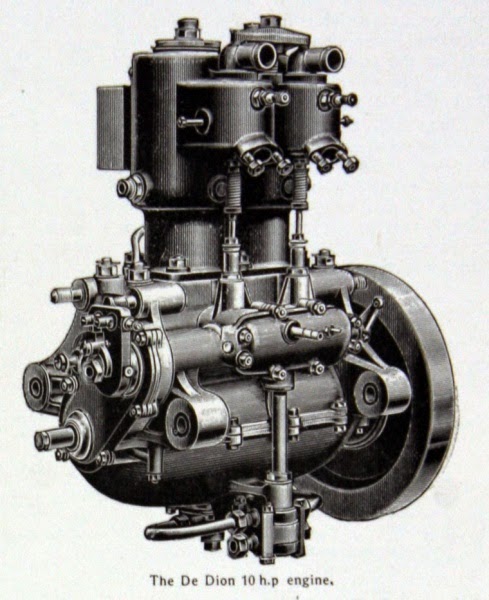
Neal spends a chapter describing his boats, the first was a converted ships lifeboat the second built to his specification in 1914 was 26 ft long with a 6 ft 6 inch beam. The beam was specified so the boat could pass through 7 ft locks and use “bumpers” (fenders) to protect the wooden hull; the draught was around 1 ft 6 inch because many of the canals were shallow. The engine he used was, in my view, a bit special. It was 1906 two-cylinder De Dion Bouton petrol engine rated at 12 HP and manufactured in 1906 for use in car. It had a form of magneto ignition augmented with a contact breaker. Neal moved the engine from Hector (1913) to Hector Too (1914). I searched the web and found an illustration that appears to fit Neal’s description. The engine had raw water cooling and a wet exhaust. Starting was by a handle and there was no electrical system on the boat.

De Dion 1906 Petrol Engine

The shadow of the Great War hangs over the book since the author wrote it shortly after the armistice and it is about cruises made just before hostilities began. Neal occasionally makes references to the Royal Flying Corp (RFC). At one stage describes flying over the Caen Flight on the Kennet & Avon. It appears that Neal was a 2nd Lieutenant in the RFC and his marriage in 1916 was recorded in Flight Magazine. He obviously kept a meticulous log, which formed the basis of the book, because he regularly reports details of his mileages and fuel use. 


One chapter, called “Under Way”, appears to describe an ideal day’s cruising on the Ellesmere (now Llangollen) Canal but it contains a curious description of double locks. It is possible that Neal was using artistic licence or possibly he was confused and recalled Hillmorton Locks on his Oxford Cruise. When cruising Neal usually had a male friend along for crew. The perfect day he describes includes cruising to Colmere. Along the canal they overtake several horse-drawn working boats.


So why a chapter on washing-up? The author states the obvious view (from what he describes as the fair sex) “just like a man to write a chapter about a job I can do in ten minutes”. He justifies the detail by explaining that the boat does not have an unlimited supply of hot water and has no sink. Neal appears to use canal water for cold water and heats it on a Primus Stove; two were kept on board. Neal washed plates and dishes in canal water followed a wipe with newspapers and perhaps some Vim. I realised when reading the chapter that we take stainless steel cutlery for granted. Knife polishing was an issue for Neal until he discovered “Lightning Knife Cleaner” which presumable is some form of abrasive cleaner that could remove corrosion. He also spends some time describing why fluted crockery is not a good idea since the fluting retains dirt. Although devoting a chapter to washing up was probably over the top, I can see, given the absence of facilities on his boats, why it was a particularly focus. A far cry from modern canal boats with all their facilities.


Neal eschewed newspapers (except for washing-up) while boating, so on August 4th 1914 he was unaware of world events and was enjoying boating on the Ashby Canal. That evening he got to just beyond Hawkesbury Junction. By the following afternoon he had reached Braunston and visited the village for supplies. Asking for a pound of butter he was greeted with “I might let you have half because I don’t know when will get more”. At was then that he discovered that the country was at war with Germany and. supplies of food suddenly had become very difficult because of panic buying. Crucially for his boating, petrol also became quite difficult to obtain because of government restrictions. Neal was told that it was required by the RFC. 

Neal passed through Foxton in 1914 on his way back home to Derby from Oxford


Neal ends his book by returning to his home near Derby from his 1914 Oxford Cruise with typical analysis of his log books. “380 miles, 189 locks, 40 gallons petrol and 9 ½ miles per gallon”. This was followed by another tribute to the charms of boating.

A charming evocative book from a century ago when life on the waterways and our country were very different. Although the book is quirky it is also has historical interest. Once I started reading it I just couldn't put it down. Copies are not particularly cheap, I paid over £30 for my copy, but it was printed on good quality paper with good binding and my copy is in excellent condition.