U-Boat Narrowboat and Albert's Starter Motor

Last night I read about the U-Boat replica narrow boat on the Narrowboat World web site. Today its featured in the Guardian and the Daily Mail, although its interesting that British Waterways don't think she has a licence. Perhaps that's why the owner appears illusive, according to the Guardian.

The Royal Navy used to run warship-outlined narrowboats in the 1970s. I understand that one was a ballistic missile submarine. It appears that Waterways World ran an article about them in July 1977- all part of recruitment.

As one who was interviewed by the River Police about my terrorism threat before tackling the tidal Thames past Whitehall, I wonder what their approach might be to mini warships passing Parliament?

Albert's starter motor troubles are a little more serious than I originally thought. I have now sorted out a service exchange deal for a new motor. I will post more news when I get the problem sorted - hopefully early next week.

Boat Average Speed

With modern technology we are familiar with instrumentation providing lots of information about the performance of machines and equipment. Our Volvo car provides information to the driver on average and instantaneous fuel consumption, how many miles to the next refuelling, and average speed.

Albert, of course, is very low-tech with just oil pressure and water temperature gauges in sight of the steerer. However, below decks there is the control panel that was supplied with the engine. It contains water temperature and oil pressure gauges, an electrical hour meter and a mechanical revolution (RPM) meter. It was the the last two that got me thinking.

I scarcely note the RPM meter except when moored-up or when someone else is steering. However, when asked "What engine speed do you use when cruising?" I usually answer "Between 500 and 600 RPM on canals and maybe 750 RPM maximum on rivers". It has recently occurred to me that because the original mechanically-driven RPM meter incorporates an equivalent hour meter I actually have information available for a more accurate answer, at least on the overall average speed.

The mechanical hour meter effectively counts engine revolutions but it displays them as hours assuming a speed of 1500 RPM. If you are operating an engine at constant maximum speed, for example in a generator set, then this would be very useful information - particularly for servicing. On Albert I had yet to find it useful but recently I decided that it might have a use in calculating the average speed of the engine.

I believe the electrical hour meter was installed new with the engine and that the mechanical hour meter was set to zero on delivery; certainly I have not reset them and a majority of the hours on the engine have now been done in our ownership. So, taking the mechanical meter reading (at the moment 838.4 hrs) dividing this by the hours done measured by the electrical meter (at the moment 2381 hrs )and multiplying this by 1500 (the nominal RPM), should give the average RPM achieved by the engine. The answer is 528 RPM.

This sounds about right given the occasional higher speed periods spent travelling along rivers and the periods spent idling in locks.

Surprising what information simple technology can give. Of course it isn't directly accessible and it doesn't come up on a fancy display at the touch of a button!

Stoke Bruerne at War

We visited the third Village at War weekend at Stoke Bruerne on Saturday. I don't know how we missed the first two but this weekend's activities made us wish we hadn't. It was quite frankly a remarkable event. The organisers, the Friends of the Canal Museum, the Canal Museum and the village, should be very proud.


Field Marshall Montgomery & colleagues


1940s re-enactors

The weather yesterday was kind, and the crowds came out in force, but today I suspect they may have suffered with the same rain problems as the Ryder Cup in Newport. We had planned to go up to Stoke by boat for the whole weekend but Albert has suffered an electrical problem. The starter motor solenoid appears to have developed a fault and I am certainly not strong enough to start the engine by hand!


Replica Spitfire Mk IX EN398 on show

The first thing that struck us, as we got to Stoke, was the large number of people wandering about in 1940s costume. There were numerous re-enactors playing Land Army girls, the Home Guard, politicians (Winston Churchill), members of the RAF and Army, and civilians of all trades. There must have been well over a hundred people in costume. It was, of course a photographers dream and many cameras with large lenses were in evidence.


LDV, USA airman and civilians
(Note the Silver Cross Pram)
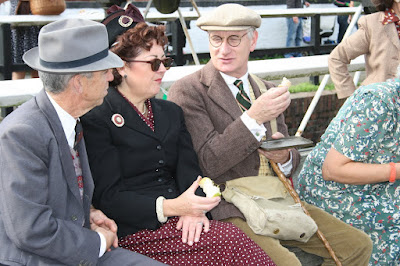

Authentic 1940s picnic

The whole village had adopted the wartime spirit with houses with taped-up windows and bunting, and the primary school acting as a Lyons Corner House. There were displays of military equipment; including jeeps, armoured vehicles, a replica Spitfire with a working Merlin engine, and a wide selection of 1940s cars and vans.


Vintage Helter Skelter

The boaters, of course, played their part in creating a 1940s atmosphere with crews of working boats in costume. Several of the more familiar working boats attended including Raymond & Nuffield, the tug Pelican, the museum's Sculptor, Cyprus, Victoria, Angel and Corona.


NB Angel being polished

Amongst the boats was also Hadar. We have passed Hadar when boating, notably at High House, but have yet to meet fellow bloggers Keith & Jo so it was great to stop and have a good chat with them. They were, of course in costume.


Jo from NB Hadar in costume


Keith and NB Hadar

We were particularly taken with their bargain Measham teapot. Although it is not perfect, it has a few chips, it certainly looks the part.


Keith & Jo's Measham being admired

There was music in the form of a George Formby tribute performing in a air raid shelter under the canal bridge.


Paul Casper aka George Formby performing

There were some really interesting displays in the military display area. We were particularly taken by the authentic Ministry of Food caravan where advice on cooking spam, and cheesecake without cheese, was available. The samples didn't look very palatable!


Ministry of Food advice caravan

Just before we left for home we found one of the cottages in Stoke were selling pumpkins; not long to halloween. The purchaser looked very pleased with his purchase.


Pumpkin and its proud owner

You will note that I resisted the temptation to reproduce the images in this blog in sepia. I bet lots of images taken at the event will!

Cars on Boats

A few years ago I remember being surprised, and somewhat taken, by the sight of a car mounted on the stern of a barge passing along the Rhine at Basel in Switzerland. The car was the original Fiat Panda. The utility of the Panda appeared to fit in with the workhorse nature of the barge.

On our recent day trip down the Rhone we saw several barges and nearly all had cars on board; ranging from modest saloons (i.e. the modern day equivilent of the Panda) to a Mercedes saloon.


A Mercedes coupe on a barge


Two cars on a barge!

The most spectacular car on boat example, however, wasn't on a large boat but on a small British registered boat - the Sarah Ann. She was making her way upstream past Avignon with a small British registered car on board. Getting the car on and off must be fun. What a great sight!


Sarah Ann and its small saloon

River Rhone

Over the last two weeks we have been in France, on a short break in the south and then on to a conference in Clermont Ferrand. We spent several days in the delightful city of of Avignon. The trip down there, by Eurostar and TGV was very quick and far less hassle than flying.

Avignon, the home to nine popes in the 14th century, is a walled city and stands on the banks of the Rhone. Being a UNESCO world heritage site it is a destination for many Europe-wide river cruises. We couldn't resist have a day's boat trip so we booked on the boat Mireio which runs day return trips down river to Arles.

The 50m long boat Mireio starts its cruises by running upstream past the four remaining arches of the collapsed bridge that the song made famous before turning downstream. The bridge at Avignon is actually called the St Benezet bridge. It has a spectacular setting when viewed from the Rhone with the magnificent Pope's palace behind.


MV Mireio passing the St Benezet bridge, Avignon

The whole journey on Mireio is based around having lunch (very French). Passengers are shown to their dedicated table on departure and then served a five course meal over the next couple of hours as the boat goes downstream to Arles. At any time you break off from eating and go on the upper deck and view the scenery. We did this rather a lot.

The journey downriver started by passing under the railway bridge designed by Eiffel. The air draught (headroom) under the bridge was very restricted even at summer water levels; presumably this is why nearly all the large river ships and barges have very low bridges or bridges that can be lowered. The TGV (railway) bridges just downstream of Avignon are somewhat different being very high and spectacular pieces of modern civil engineering.


Squeezing under the Avignon rail bridge


TGV bridges at Avignon


Overtaking barge Walhall

We passed through the lock (ecluse) at Beaucaire. This is the last lock on the Rhone's route to the Mediterranean. The neighbouring Vallabrègues dam produces 210 MW of hydro electricity. The lock dimensions are very impressive. It is 190m long and 12m wide with a 16m rise/fall. All boats have to be tied off (onto impressively large floating bollards) and life jackets are mandatory. On the way downstream we were joined at the lock by a working barge (Walhall) and a couple of small cruisers. On the way back upstream we were joined at Beaucaire by a flotilla of small boats including the a very small British flagged fibre-glass cruiser that had some difficulties staying tied onto the bollards as the lock filled.


Floating bollards, Ecluse Beaucaire


"Going Down" - 16m fall


Leaving Beaucaire Lock

Below Beaucaire the river is less wide and the current appears stronger. Over this stretch I tried photographing the captain steering the boat. Recognising a boating enthusiast, he kindly invited me onto to the bridge where we had a difficult conversation in my very rusty French on how the boat was operated, its dimensions, speed and draught etc. His use of radar and GPS was interesting.


On the bridge of the Mireio


Chateau de Tarascon

We moored up at Arles behind a number of large river ships. They looked enormous and very long and sleek. However, it turns out that most are designed with somewhat similar proportions to the standard English narrow boat. The River Royale, for example is 360 feet long and 37.5 feet beam - just about six times bigger than Albert.


Mireio moored at Arles

Arles has great historic roots with a Roman coliseum and amphitheatre along with its Van Gogh connections. We only had a couple of hours to explore it, and it was a hot day 31 deg C, but it has quite a lot going for it in terms of charm and interest and it was well worth the visit - especially by boat (of course!).


Large river ships moored at Arles