Great Ouse Limit of Navigation

As with most river navigations, the limit of navigation on the Great Ouse depends on your vessel. Most Environment Agency advice and mapping runs out at the Embankment at Bedford with passage under the 2.1 m air draught under the footbridge at the town's lock.

I had always taken it for granted that the practical obstruction to navigation for most boats was the lack of headway under the railway bridges in Bedford. We have not navigated to Bedford but today I spent some time today walking along the river and by chance I was able to see for myself how one of the railway bridges impacts on navigation.

As I walked from the former Britannia Iron Works site, across the new footbridge, a small GRP cruiser approached the Bletchley to Bedford railway line bridge from downstream It decided that it couldn't go any further, turned and moored up by Borough Hall where there are good moorings. This bridge has a nominal air draught of 1.96 m, according to a Bedford Borough Council document. Although the cruiser could have dropped its windscreen, and possibly made it under the bridge, it did look very tight. With the proposed route of the Bedford & Milton Keynes Waterway entering from just upstream of this area, a solution is required for this and the St Pancras line bridge which is only a few metres upstream and only a little higher.

 
Cruiser chooses not to risk it under a rail bridge at Bedford


Stoke Bruerne

Spent Tuesday afternoon in Stoke Bruerne at the Canal Museum with my grandson Hugh. He was particularly fascinated by the models on canal construction and the locks/incline plane at Foxton. We both enjoyed a boat trip on Charlie. Nice to be steered into the tunnel and Hugh was very brave when the lights were turned off - we could just see the pin prick of light at the other end.

Hugh on Trip Boat Charlie

I shall soon be going on Charlie again as part of the Over and Under the Hill event on Sunday 3rd September, although that will involve going right through.


Keep Left?


I had taken for granted that, except for special circumstances, boats PASS ON THE RIGHT (i.e. port-to-port).  This accords with the international rules of navigation and all current and recent guidance confirms this (e.g. from BW, CRT, IWA, EA) .

I had also assumed that this guidance was both universal and historic. However, I recently obtained a 1950 1st edition of the Inland Waterways of Great Britain & Northern Ireland by Lewis A Edwards and a section in the book led me to consider that some navigations required boats to PASS ON THE LEFT, perhaps as recently the nineteen-forties.

In the appendix to the book there is a note on Navigation Hints for Pleasure Craft. The note provides interesting insights into the days when our canals and rivers were first and foremost commercial highways. It provides lots of helpful advice on how to ensure working boats are not impeded; one can easily imagine the frustration of working boatmen with amateur crews, particularly at locks.  

Concerning boats passing, the advice is clear:

"On our rivers, and over most of the canal system, ... the passing rule is KEEP RIGHT; but there are exceptions to this such as the Worcester & Birmingham Canal, where the rule is KEEP LEFT"

The writer goes on to advise pleasure craft crews to ask boatmen. This came as a surprise to me since I had not read anything similar. 

The book is edited by Lewis Edwards who is credited as being Honorary Secretary of the Inland Waterways Association. It largely consists of factual material but the note about navigation was written by none other than Tom Rolt. The advice originally came from a leaflet originally published by the IWA. Tom Rolt was Honorary Secretary of the IWA until 1950, the year of the book's publication and Lewis Edwards was in the process of taking over his role. Later in the year considerable changes occurred in the IWA with "Civil War" breaking out. Rolt and others resigned.  

Some questions arise from the note:

Is there other evidence for this navigation advice?

Does the particular reference to the W & B come because Rolt was moored up for several years at Tardibigge? 

Did canal amalgamation, and ultimately nationalisation, bring uniformity or were there other reasons? 

When did uniformity occur?


I can recommend the book as offering insights into an interesting period of waterways history; on the cusp between commercial and leisure boating. It is easier to navigate (pun intentional) through its chapters to find a particular waterway than Bradshaw, which annoyingly groups navigations by their ownership (mostly railway companies) and not by geography or given name.  My copy was not expensive, obtained via eBay and is in good condition.

Journey Home from the Oxford Canal


Having been away in Cornwall for the last week, I feel obligated to round-off my belated posts of our late July cruise to and from the Upper Thames. After a night at Wormleighton, on July 23rd we worked our way north along the Oxford canal, descended Napton flight and mooring up in Braunston for the night. It was relatively quite in Braunston, probably because the fine weather had brought out the boats. The lovely moorings near Flecknoe were busy. We had a visit to Midland Chandlers and than eat at The Boathouse with our daughter, son-in-law and their two children. A pleasant night. 
Rowing Skiff passing through Braunston
(with appropriate dress)

As we walked around Braunston we noted that the Sea Otter which had caught fire, and was reported by Halfie, had sunk. As reported on Halfie's site aluminium does burn. The boat looked a macabre site. 

A sad site

Sunken Sea Otter at Braunston

By the next day the weather had turned and we had a damp journey up Braunston flight and through the tunnel. Met a boat coming the other way with two bright LED work lights that lit up far into the distance but made navigating past difficult. I still can't understand the need to long range illumination as I noted some years ago.

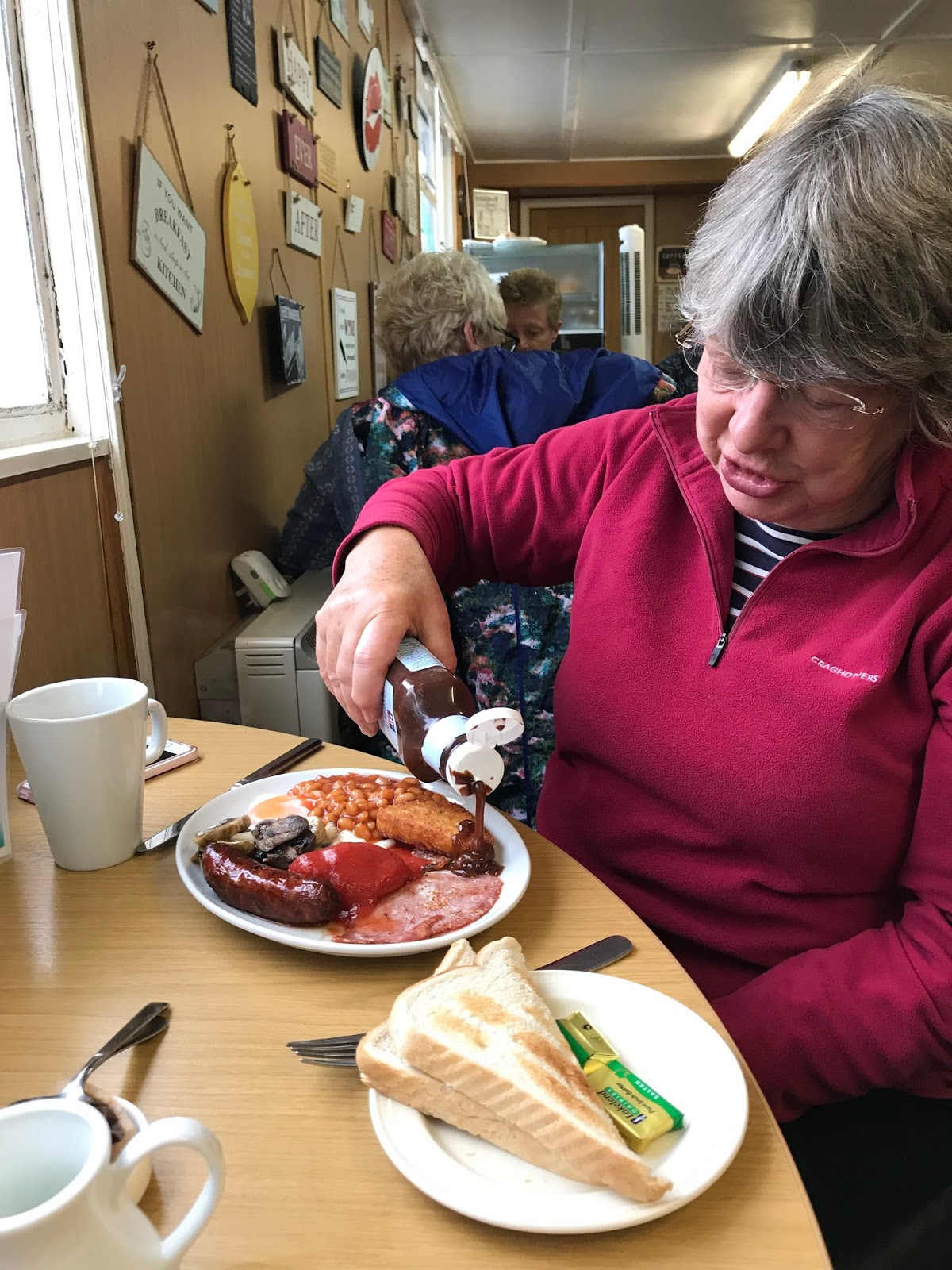
We went down Long Buckby flight as the weather cleared. It was good progress until the last two locks where a boat waited for another to join it in the lock only to split up a pair and cause another boat to operate as a single. Sometimes this sort of "politeness" actually causes more difficulties.  A late lunch was called for and we went into the Lockgate Cafe at Whilton Marina for an all-day breakfast.

Adding the ketchup

That night we moored at Flore opposite the small caravan site. Around five caravans were parked up and enjoying the view. In the morning, we visited Colin Dundas at High House to discuss a possible repaint of Albert. It looks like we shall "bite the bullet" and have a refurb next year.

The journey home via Blisworth tunnel and Stoke Bruerne was largely uneventful. It was good weather although the heavens opened for a short time as we arrived at Stoke for lunch. The morning trip was largely uneventful but I did witness ridiculous boating near Heyford. As we left Furnace Wharf, and turned the corner onto the long straight towards Bugbrooke, I saw a boat approaching with a wave behind it that looked just like the Severn Bore - a swan family behind the boat were struggling to cope! The boat was obviously going at some considerable speed, maybe flat out. I have never seen a canal boat cause such a large wake. The steerer quickly slowed down as we approached and I proffered my usual sarcastic comment "lost your water skier?". I then realised that my humour was not going to work and I am sorry to say I resorted to some plain speaking. Judging by the reaction of the other crew they thought I was being unreasonable mentioning their speed and bank erosion. 

After lunch we went down the Stoke flight on our own because, being quiet, I was able to set locks ahead. We arrived home at Yardley Gobion in the late afternoon to begin the process of unpacking.

Braunston sun set
   

Wormleighton Owl

On our way back from the Upper Thames we moored overnight at one of our favourite mooring spots just after Bridge 130 on the Oxford Canal just overlooking the radio mast that resembles the Eiffel Tower.
South Warwickshire at its best

It was warm and sunny and we got out the folding chairs and admired the view using our binoculars. It wasn't long before another boat arrived and moored up close to us. They also got out the folding chairs, cracked open a bottle of wine and started looking through binoculars. They didn't look across the valley towards Napton as I expected, where there is the best view), they looked at the wheat field. It soon became obvious that they were looking at birds flitting across the top of the crop. Quite soon they and us spotted a buzzard perched on the top of a power-line post. This looked interesting but not that easy to photograph. It was then they let slip that mooring at Napton they had heard stories of barn owls in this spot.

Barn owl arrives & hovers


Within minutes, and unannounced because they are silent on the wing, a barn owl arrived. I got out the SLR and then started snapping. The owl put on a good show swooping low across the field. It look glorious in the late evening sunlight. It then disappeared for a few moments only to reappear, swop down into the crop, and then fly off with its kill - a small rodent held in one claw. Presumably going back to its nest and hungry young.

Patrolling the hedge

Barn owl and prey 
Just one claw required!


Glorious sunset at Wormleighton
A great sight and a great mooring!